When can I practise sport after a meniscus surgery?
- What influences the recovery from surgery?
- Time to get back into sports
- Are you considering meniscus surgery?

Come to Spain for your surgery or treatment
We manage everything from start to finish
- In the vast majority of cases in which a patient undergoes meniscus surgery, what matters most to them is when they will be able to return to sport.
- The recovery time is determined by two main factors, the type of surgery and the intensity of rehabilitation.
- To return to sport after meniscus surgery at 100% it usually takes about 4-6 weeks after a partial meniscectomy and about 3-4 months after a meniscal suture. Here we talk about it.
When a patient comes for a surgical assessment consultation for meniscus arthroscopy with one of our specialists in traumatology, one of the questions they always ask is when they are going to be able to play their sport again.
One of the reasons why they ask so many questions is because meniscus tears, although not always, tend to occur during sport, and are common in sports such as football and basketball.
Although not all meniscal tears need to be operated on, in some cases conservative treatment can be chosen, in young patients who play sport, the surgical option is almost always chosen. In this article we will focus only on cases in which meniscus surgery is performed by arthroscopy.

Do you need meniscus surgery?
Request a free and immediate appointment with our specialists in Traumatology
What influences the recovery from surgery?
There are a series of aspects to take into account in the recovery time after meniscus surgery to determine whether it will be longer or shorter. Although the average time to return to sport is about 4-6 weeks after a partial meniscectomy and 3-4 months after a meniscal suture, in some cases it can take up to 6 months. Everything always depends on each case.
The factors that influence this are the following:
Approach technique
The most common approach is arthroscopy; the open approach is only used in cases where, in addition to the meniscus, the ligaments and part of the bone are damaged, usually due to traffic accidents.

If it is a normal meniscus tear, the technique is arthroscopy, which consists of making 2 or 3 incisions on the sides of the knee, through which a tiny camera is introduced, allowing the doctor to see the inside of the joint on a monitor, and the surgical instruments through the others.
This allows the surgeon to repair the meniscus without having to open the joint, which allows for a minimum hospital stay of 24 hours, as well as a shorter recovery time due to the fact that hardly any joint tissue has been affected.
On the other hand, in addition to the surgical approach used, the type of meniscus repair performed must also be taken into account:
Type of repair
Although a mixture of both is usually performed, meniscus repair can be performed using two techniques:
- Partial meniscectomy: This is usually performed in cases where the tear, or part of it, is in the non-vascularised area of the meniscus, so it cannot regenerate on its own and the only option is to remove it.
- Meniscal suture: In this case, the torn part of the meniscus is sutured. This option is carried out, on the contrary, in the vascularised area (which receives blood supply) which allows regeneration. This is the main technique used in young people and athletes. It has a slightly longer recovery time than the other, but it is worth it as most of the meniscus is preserved.
As we mentioned, it is common for the tear to affect both areas of the meniscus, and it is vital to have a surgeon specialising in traumatology and orthopaedic surgery who has experience in performing this type of intervention.
In any case, despite the influence of this, what makes the most difference in terms of recovery time before returning to sport is the intensity of the rehabilitation.
Intensity of rehabilitation
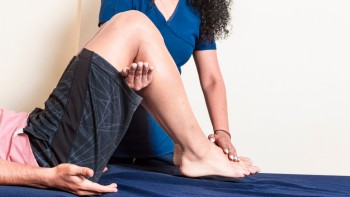
Although it is not recommended to subject the operated leg to a lot of effort during the first few weeks, it is advisable to mobilise it, as this allows you to avoid losing a lot of muscle mass, something that happens if you do not move your leg for a long time, as well as speeding up recovery thanks to the blood supply to the area (as you can see, in the end the most important thing is that the blood goes to the area and fixes it).
It is also necessary to be careful and it is advisable to carry out rehabilitation with a physiotherapist to help you, as the more personalised the better.

Free Assessment for Contracting Medical Services
Operarme’s Patient Service will contact you and solve all your questions on the medical service you need.
Time to get back into sports
During the first few weeks after the operation, the patient will usually feel swelling in the knee and discomfort with some pain. This is absolutely normal and nothing to worry about. The surgeon will probably have prescribed anti-inflammatory drugs, painkillers for the discomfort and will have instructed you to lift your leg and apply ice several times a day.
Beyond that, the leg should be mobilised as previously indicated, but always making sure that the operated knee does not bear the full weight of the body. The use of crutches after the operation for 4 or 5 days (longer if a meniscal suture has been performed) is only to help the patient maintain balance and not to force the joint.
As the patient progresses through the exercise programme, the patient will focus on strengthening the muscles that provide the knee with stability, such as the quadriceps, hamstrings and glutes, as well as those that allow the patient to regain the full range of motion of the joint.

Rehabilitation is always personalised, and there are cases in which after the first month, gentle continuous running can be started, which is common in patients who were previously sportsmen and women. It is therefore recommended that rehabilitation be carried out with a physiotherapist on a personalised basis.
In general, the patient can normally return to normal activities 2 or 3 weeks after the operation, while a full return to sport will take from 4-6 weeks (partial meniscectomy) to 3-4 months (meniscal suture).
Are you considering meniscus surgery?
If you are thinking of having meniscus surgery privately, you can request a free surgical assessment consultation with one of our specialists to meet you, so that they can assess and familiarise themselves with your case and between the two of you decide on the best option.
Request a free assessment consultation, click on the following image:
Do you need meniscus surgery?
Request a free and immediate appointment with our specialists in Traumatology
Come to Spain for your surgery or treatment
We manage everything from start to finish
Medical disclaimer: All the published content in Operarme is intended to disseminate reliable medical information to the general public, and is reviewed by healthcare professionals. In any case should this information be used to perform a diagnosis, indicate a treatment, or replace the medical assessment of a professional in a face to face consultation. Find more information in the links below: