Rehabilitation after arthroscopic meniscus surgery
- Postoperative period after meniscus arthroscopy
- Meniscus rehabilitation exercises
- Bibliography
- Source information
- Frequent Questions

Come to Spain for your surgery or treatment
We manage everything from start to finish
Arthroscopic surgery is a modern minimally invasive technique: damage to the skin is minimal, which greatly shortens recovery times. In contrast, the rehabilitation time after open surgery is much longer because of the damage to the knee tissues.
Postoperative period after meniscus arthroscopy
After meniscus surgery, the hospital stay is very short, and patients are usually discharged on the day of surgery. However, as mentioned above, the knee will take weeks or even months to heal and regain full mobility. Factors that can affect recovery time include the severity of the meniscus injury and the technique used by the surgeon to repair it.
Some of the recommendations to follow immediately after surgery are:
- Avoid putting your full weight on the operated leg during the first few days. Walking with crutches is recommended, as instructed by the specialist.
- Medication may be prescribed to control pain and swelling.
- Keep the knee elevated.
- Apply ice to the operated area to reduce swelling.
- Do progressive movements with little weight-bearing. This helps activate the muscles, prevents muscle wasting and improves blood flow to the joints, as long as the movements do not put the surgery at risk.
In addition to these general guidelines, follow-up with a specialist in meniscus rehabilitation is recommended. In the next section we explain the exercises recommended for a quick and successful recovery.
Meniscus rehabilitation exercises
The exercises are designed to restore the normal range of motion of the joint and strengthen the quadriceps, at the front of the thigh. They can be done at home, although some patients will need physiotherapy sessions.

Some of the physiotherapy techniques used for meniscus rehabilitation after surgery are:
- Manual techniques to release adhesions in the connective tissues of the joint.
- Coordination and balance exercises for the muscles that stabilise the knee.
- Electrical stimulation to strengthen the muscles around the joint.
- Passive mobilisation to regain range of motion.
- Manual therapy to reduce discomfort and pain.
If you are looking for the right specialist near you, our physiotherapists specialising in meniscus rehabilitation offer packs of 5 and 10 sessions:
- 5 meniscus rehabilitation sessions | from €160
- 10 meniscus rehabilitation sessions | 420 €
Other exercises you can do at home include:
- Gently straightening the knee with a rolled towel under the ankle.
- Active-assisted extension: using the healthy leg together with the strength of the quadriceps to move the knee from 90° to full extension.
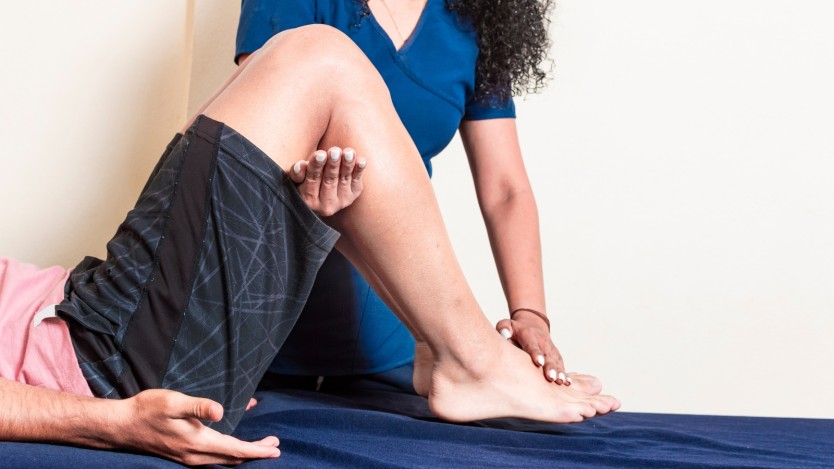
- Progressive passive knee flexion up to 90°:
- Sit on the edge of a table and let your knee bend under gravity.
- Use your other leg to increase the bend.
Full recovery usually takes about 4-6 weeks after a meniscectomy and about 3-6 months after a meniscus repair, but this always depends on the patient, the severity of the injury and the intensity of the rehabilitation. What is certain is that rehabilitation after an arthroscopic procedure is shorter than after conventional open surgery.

Do you need meniscus rehabilitation?
Request a free appointment with no waiting time with one of our specialists
Bibliography
- Instituto Cordobés de Traumatología. (2003, October). Protocolo de rehabilitación de la sutura de menisco. http://institutocordobestraumatologia.com/pdf/Rehabilitacion%20sutura%20menisco.pdf
- Busto Villarreal, J. M., Liberato González, I., & Vargas Sánchez, G. (2009). Lesiones Meniscales. Medigraphic, 5(1), 39-48. https://www.medigraphic.com/pdfs/orthotips/ot-2009/ot091d.pdf
- Alan Barber, F. (2013). Rehabilitación acelerada en reparaciones meniscales. Artroscopia, 10, 206. https://www.revistaartroscopia.com/ediciones-anteriores/54-volumen-05-numero-1/volumen-1-numero-2/345-rehabilitacion-acelerada-en-reparaciones-meniscales
Come to Spain for your surgery or treatment
We manage everything from start to finish
Dr. Antonio Rebollo Marina
Médico Asistencial en Centro Médico Caser
Nº colegiado: 282834715

Medical disclaimer: All the published content in Operarme is intended to disseminate reliable medical information to the general public, and is reviewed by healthcare professionals. In any case should this information be used to perform a diagnosis, indicate a treatment, or replace the medical assessment of a professional in a face to face consultation. Find more information in the links below:
Frequent Questions
-
It depends on the technique: after a partial meniscectomy it usually takes 4 to 6 weeks, and after a meniscus repair, 3 to 6 months. Read more.
-
Some of the immediate recommendations after meniscus surgery are: Read more.
- Use crutches for the first few days, as instructed by the specialist.
- Keep the knee raised to control swelling after surgery.
- Do not stand for long periods or play sports until the specialist says so.
-
- Avoid activities that involve heavy weight-bearing or long periods on your feet.
- Apply cold to the knee and keep your leg raised on cushions.
- Take painkillers as recommended by your doctor. Read more.