Recovery time for a Knee Replacement
- What is the recovery time for a Knee Replacement surgery?
- How is the post-operative period after a knee replacement surgery?
- Exercises for knee replacement
- Knee rehabilitation with Operarme
- Frequent Questions

Come to Spain for your surgery or treatment
We manage everything from start to finish
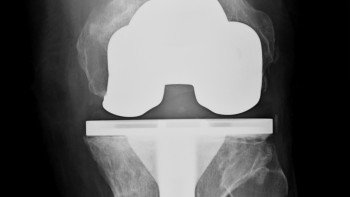
Knee replacement surgery is a surgical intervention in which the damaged knee joint is replaced with an artificial structure in order to regain mobility and leave behind the chronic pain suffered by patients with this condition.
Despite being a fairly common and technologically advanced surgery , the recovery time for the operation is 4 to 6 months, with full recovery being achieved one year after the surgery.
Below, we tell you more about the recovery time for the surgery, the importance of care during the post-operative stage, and we recommend some exercises to help combat knee stiffness and gradually regain mobility in the joint.
What is the recovery time for a Knee Replacement surgery?
The total recovery time for a knee replacement is 4 months to 1 year.
Generally, the patient regains their mobility and autonomy within the first six months after surgery, but the recovery process following a prosthesis implantation is not immediate and requires care, patience, and exhaustive follow-up of the post-operative instructions provided on the day of discharge.
The stages of the recovery process after a prosthesis operation are mainly as follows:
- Hospital stay: the patient remains admitted to the hospital for 2 to 4 days (depending on their post-surgical progress) and in the first 24-48 hours, with the help of a walker, they must stand up and take a few small steps. It is important to start performing movements during this period of time to avoid possible complications.
- Initial stage at home (1-4 weeks): this is the decisive phase of the recovery process, as the patient must work to strengthen the operated knee joint by performing essential tasks around the house, in addition to walking. If you are interested in learning more about the care that must be taken into account during recovery at home, we invite you to read our article ‘Knee prosthesis. Recovery time at home’.
- Follow-up stage (3-6 months): in this phase of recovery, the patient regains much of the strength and flexibility of the joint: the prosthesis integrates properly during this period if the recommended instructions and exercises have been followed consistently. During this stage, the patient can return to their work and/or daily activities, provided that these do not require great physical effort. The length of sick leave after a prosthesis operation is generally 2-3 months if the patient has an office job, about 3 to 4 months if their work involves standing and moving during the working day, and in the most extreme case, if they have a job that involves heavy lifting or great physical effort, 4 to 6 months are granted.
- Full recovery (1 year): One year after the knee replacement implantation, the healing of the internal tissues is almost 100% complete. In this final phase of the recovery process, residual swelling disappears and maximum movement in the joint is achieved.
How is the post-operative period after a knee replacement surgery?
The post-operative period of a knee replacement operation is a gradual process involving the effort and consistency of the patient, and medical care.
- Wound care: it is important to keep the area clean and dry to avoid infections and to follow the instructions in the medical report for its care; staples or stitches are eventually removed approximately 2 weeks after discharge.
- Pain medication: upon discharge from the hospital, the patient receives a medical prescription for strong analgesics and also anti-inflammatory medication to help manage the pain in the following weeks until it disappears.
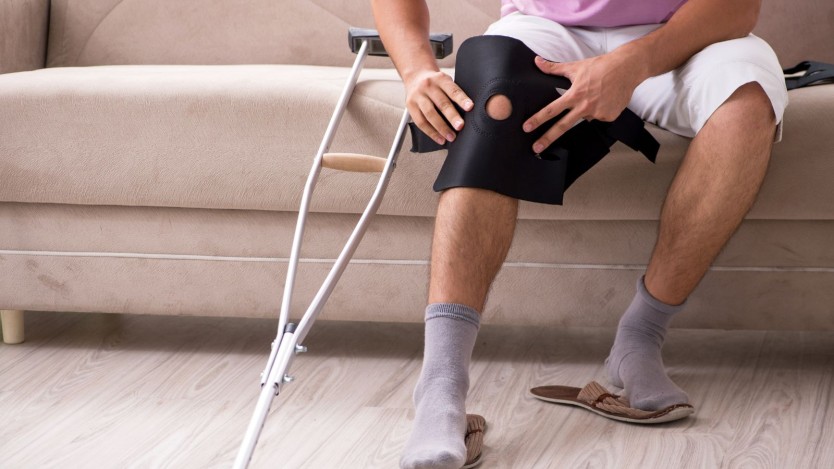
- Use of crutches or a walker for support when walking, especially during the first few months, until a stable and autonomous gait is regained (the patient usually stops using crutches for support from the 6th week of recovery).
- Movement and exercise: the objective of the recovery phase is for the implanted prosthesis to end up integrating properly into the joint, and for this reason it is important to start exercising the knee gradually: first walking at home with the help of a walker or crutches, performing basic flexion and stretching exercises, and then from the 3rd or 4th week, leaving the house for short walks. It is also recommended to perform a series of exercises that boost musculature and strengthen the joint. Below, we show you several simple exercises that can be performed at home to work on knee rehabilitation.
Is the post-operative period of a knee replacement painful?
Yes, it is normal and common to experience pain in the area during the post-operative period, especially in the 48 hours following the surgical intervention.
The pain in the operated knee gradually decreases as the weeks pass and the swelling goes down.
Even so, the patient should not worry as this phase can be managed with the help of analgesics and anti-inflammatories that are prescribed upon hospital stay discharge.
Exercises for knee replacement
One of the most decisive parts of the post-operative stage of a knee replacement surgery is physiotherapy.
Exercising the operated knee little by little helps to prevent knee stiffness, improve circulation to avoid blood clots, prevent the knee quadriceps from atrophying, as well as assisting with the integration of the prosthesis into the knee.
We list below some simple and basic exercises that can be performed in different phases of the recovery stage:
Initial phase (1st and 2nd week)
During the first two weeks at home, it is advisable to move your feet up and down to promote circulation in the feet and legs (ankle pumps).
Another recommended exercise is to raise the leg in a straight position a few centimetres off the bed for about 5-10 seconds in order to gradually gain strength in the muscle.
Mobility phase (3rd to 6th week)
In this period, the aim is to work the knee quadriceps as it is the 'motor' of the knee.
A basic exercise is to practice knee flexion in a chair: the seated patient has to slide their heel backwards to practice flexibility. Another exercise to perform is to place the heel first and then the toes when walking to improve the progress of the walking time.
Strengthening phase (from the 6th week onwards)
In this phase, the strengthening and consolidation of the joint are worked on. As the weeks pass, the patient returns to daily and even work activities; this contributes to greater movement and exercise of the knee. Even so, it is recommended to continue with the previous rehabilitation, in addition to progressively performing exercises such as pedalling on a stationary bicycle, or performing partial squats while supported on a stable surface, but without actually kneeling, only flexing at an angle of 30 to 45 degrees (as if making the motion of sitting in a high chair, but stopping much sooner).
It is very important to work on knee extension from the very beginning, but the joint should never be forced if pain is present.
If you are interested in more detailed information about recommended exercises during the post-operative stage, you can click on our article “Rehabilitation exercises after a knee replacement” to find out more information.
Knee rehabilitation with Operarme
As we have mentioned throughout the article, knee rehabilitation is a decisive part of the success of the surgical process when a prosthesis is implanted.
In the event that your specialist recommends a more professional rehabilitation, or if you are interested in working on this part of the rehabilitation with a Physiotherapy specialist, at Operarme we offer you the service of packs of (5 or 10) Knee Rehabilitation Sessions available in different cities and clinics specialising in Physiotherapy and Rehabilitation.
If you are interested in purchasing rehabilitation sessions, you can click below on the pack of sessions that interests you most:
If, on the contrary, you have not yet undergone surgery but are in the process of informing yourself about the procedure and considering having surgery, do not hesitate to contact our Patient Service team to resolve your doubts by calling at +34 91 141 33 56, or by sending a message through our contact form.
You can also directly request a surgical assessment consultation with one of our specialists in Orthopaedic Surgery by clicking on the following banner:

Do you need a Knee Replacement?
Request appointment for surgical assessment with our specialists in Orthopaedic Surgery, solve your doubts and confirm your surgery date.
Come to Spain for your surgery or treatment
We manage everything from start to finish
Medical disclaimer: All the published content in Operarme is intended to disseminate reliable medical information to the general public, and is reviewed by healthcare professionals. In any case should this information be used to perform a diagnosis, indicate a treatment, or replace the medical assessment of a professional in a face to face consultation. Find more information in the links below:
Frequent Questions
-
The pain gradually disappears as the weeks pass, as does the swelling in the knee. It is quite common and normal to feel sharp pain in the 48 hours following the operating room.
Even so, as we have mentioned, the pain decreases and can be managed without problem with the help of strong analgesics (prescribed upon hospital stay discharge). Read more.
-
It is important to avoid kneeling during the first 6 months after the knee operation so as not to affect proper healing.
Once the full recovery after surgery is complete, it is possible to kneel with a knee replacement, although the sensation may be bothersome or uncomfortable for the patient.
It is important to practice little by little, avoid hard surfaces, and protect the area if possible with a knee pad. Read more.
-
The length of sick leave after a knee replacement surgery always depends on the type of job the patient has:
- In sedentary or office jobs, the return to work generally occurs 2-3 months after discharge.
- In jobs that involve standing for hours, the sick leave usually lasts for 3 - 4 months.
- In those occupations that require great physical effort, the sick leave usually lasts approximately 4 to 6 months.
There are some factors to take into account that could extend the length of sick leave, such as if the patient must drive a long distance to their workplace, in which case the return to their post would be delayed, as the return to driving is slow if the knee is not yet 100% stable; furthermore, it also matters if the operated knee is the right one (in the case of driving an automatic car), or the left one (due to the clutch, if driving a manual car). Read more.