Torn knee ligaments: what are my options?
- The knee joint and its ligaments
- Knee ligaments
- Knee ligament injuries
- Symptoms of knee ligament injuries
- Treatment of torn ligaments

Come to Spain for your surgery or treatment
We manage everything from start to finish
- In everyday life it is very common to encounter knee pathologies, such as torn ligaments, associated with excessive stress on the joint.
- There are four ligaments in the knee that are susceptible to injury: anterior cruciate ligament, posterior cruciate ligament, external lateral ligament and internal lateral ligament.
- In complete tears, especially of the anterior cruciate ligament, reconstruction surgery is usually the most effective option, either by arthroscopy or conventional (open) surgery.
The knee joint and its ligaments
The knee, as is well known, is one of the most frequently used joints in our body. Both in our daily lives and when playing sport, we can suffer injuries and pathologies associated with it, such as sprains, osteoarthritis, torn ligaments, meniscus tears, among others.
It should also be noted that advances in medicine and surgery to repair these problems are getting better and better.

Do you need cruciate ligaments surgery?
Request a free and immediate appointment with our specialists in Traumatology
Nowadays, more and more people are aware of their health and that exercise is necessary for a healthy life. However, many people do not have the necessary preparation for proper training, which leads to knee ligament injuries. Even top athletes suffer from these injuries due to excessive stress on the joints.
Knee pain and injuries are also work-related problems and are one of the most frequent causes of occupational medical consultation.
Knee ligaments
The knee is made up of three bones: the femur, the tibia (or tibial plateau) and the patella, which lies in front of the femur.
The femur is made up of two femoral condyles that are rounded in shape. This rounded shape (not perfect, but rather irregular) is attached to the tibial plateau (flat), so that the two do not fit together perfectly. Here we find the menisci, which are responsible for the congruence between the two bones.
The knee joint, in turn, is formed by a series of ligaments, whose main function is to prevent dislocation or dislocation of the joint when the knee performs flexion and/or extension movements.
A distinction is made between the ligaments in the centre of the knee and the lateral ligaments. The ligaments in the centre are called "cruciate ligaments".
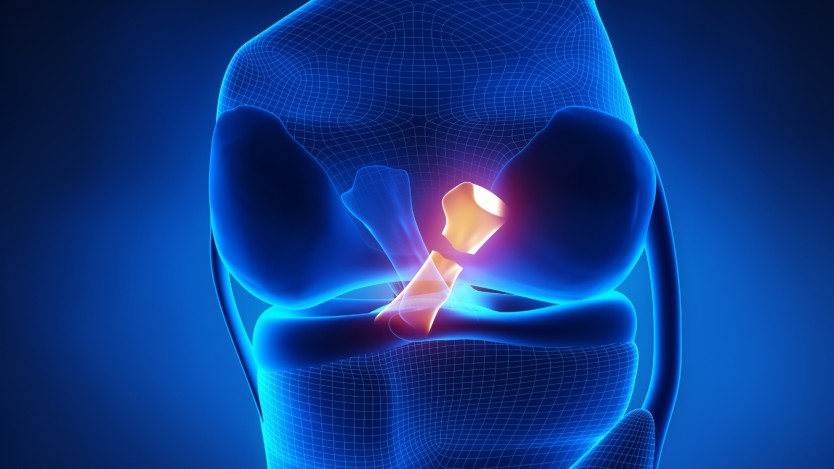
- Anterior cruciate ligament (ACL): This ligament attaches the back of the femur (lateral condyle) to the front of the tibia. The attachment of this ligament prevents a forward displacement of the tibia relative to the femur.
- Posterior cruciate ligament (PCL): Its direction is opposite to the anterior cruciate ligament. This ligament runs from the front of the femur (medial condyle) to the back of the tibia. The main function of this ligament is to prevent the tibia from moving backwards in relation to the femur.
The function of these two ligaments is to keep the joint surfaces close together. Because of this, there are always some fibres of these ligaments that are under tension.

It should be noted that anterior cruciate ligament injuries are more common than posterior cruciate ligament injuries, especially in sports with pivoting and changes of direction.
The lateral ligaments that form the knee joint are as follows:
- Internal lateral ligament (ILL): located on the inside of the knee and attaches the femur to the tibia.
- Lateral Lateral Ligament External (LLE): located on the outside of the knee and attaches the femur to the fibula. Its function is to prevent lateral movement of the knee joint.
These two ligaments limit sideways movements of the knee (inwards and outwards) and help control rotation.
The muscles that form the joint (the quadriceps and hamstrings) reinforce the action of the ligaments, giving stability and helping to maintain stability without damaging the ligaments.
Knee ligament injuries
Knee ligament tears are very common, especially during sport. What usually causes the injury is a bending of the femur in one direction, while the tibia stays still or rotates in the opposite direction to the femur.
This causes the ligaments to be strained, which become very tight and can even rupture.

If the ligaments are stretched too much (more than normal), this can lead to what is called a strain. In this case the ligaments do not break.

Do you need cruciate ligaments surgery?
Request a free and immediate appointment with our specialists in Traumatology
When they are overstretched and some of the fibres are torn, we call it a ligament sprain. The ligament can also be torn completely.
Anterior cruciate ligament (ACL) injury
This injury usually occurs by an indirect mechanism. It usually occurs when the body rests on the leg that is fixed to the ground, while the body is leaning forward, resulting in the tearing of the ligament. It often occurs during sporting activities.
ACL injuries may be accompanied by other knee injuries or occur only in the ACL.
Posterior cruciate ligament (PCL) injury
In this case, this injury is usually caused by a direct mechanism. It occurs when there is a collision of the flexed knee, resulting in a tear of the ligament. For example, it occurs when a person falls onto a bent knee or the front of the shin is struck, as in a car accident against the dashboard.
It is worth noting that the anterior cruciate ligament is the most commonly injured ligament.
Lateral Ligament Injury (LLI)
Usually caused by a blow or force pushing the knee inwards (valgus). Sometimes associated with injury to the internal meniscus.
External Lateral Ligament Injury (ELO)
Usually caused by a blow or force pushing the knee outwards (varus); it is less common than medial collateral ligament injury.
The Triad
This is the most complicated injury of the joint, as it consists of the injury of three elements: the anterior cruciate ligament, the medial collateral ligament and the meniscus.
The injury in this case occurs in the same way as the anterior cruciate ligament injury: the tibia remains still while the femur flexes. In this case, the injury occurs more abruptly, in a much more violent way.
Symptoms of knee ligament injuries
The symptoms suffered by the patient when one of the knee ligaments is torn are as follows:
- Pain and swelling of the knee: these are the symptoms par excellence, which occur as soon as the injury is sustained.
- Inability to stand or walk and to support the injured leg.
- Unsteady gait, with the sensation that the knee is going to uncouple.
- Clicking, which occurs both at the time of injury and afterwards, when making any movement of the knee.
- Effusion: in the case of the anterior cruciate ligament, this effusion occurs during the first three hours and is common, as it is an internal injury.
- Haematoma: in the case of a posterior cruciate ligament injury, this may occur in the crease of the knee.
Treatment of torn ligaments
Treatment of the knee ligament injury will depend on the severity of the injury.
If the injury is not serious, treatment will be conservative, i.e. the patient should apply ice to reduce inflammation, rest, compression with an elastic bandage and elevation. In addition to this, it is also important for the patient to see a physiotherapist who will perform a series of exercises to prevent further problems in the joint.
On the other hand, in the case of a rupture or a more serious injury, the best option for the patient is surgery to reconstruct the damaged ligaments.

Ligament reconstruction (Knee arthroscopy)
Knee arthroscopy is a surgical technique that allows the surgeon to operate on the patient by looking inside the knee without the need to make a large incision and open the knee.
This is a minimally invasive technique, as the surgeon only makes a few small incisions (approximately one centimetre) in the patient's skin. Through these mini-incisions, the surgeon inserts the surgical tools that will allow him to operate correctly.
One of these tools is a tiny camera connected by fibre optics to a monitor located in the operating theatre, which allows the specialist to see inside the patient.
Before starting the operation, the surgeon introduces a sterile solution inside the knee, which will have a balloon effect, causing the knee to swell. It also allows for continuous flushing of the joint. Because of this serum, it is normal for the knee to remain swollen for a few hours or even several days.
The anaesthesia usually used is either spinal or general anaesthesia. Once the arthroscopy has been performed and the problem has been located, the surgeon will proceed to reconstruct the damaged ligaments.
Do you need cruciate ligaments surgery?
Request a free and immediate appointment with our specialists in Traumatology
In order to replace the damaged tissue with other tissue, it will be done using tissue from the patient (autograft) or from a donor (allograft). The procedure by which ligament reconstruction is performed is as follows:
- The damaged ligament is removed with the help of the necessary instruments.
- If the surgeon chooses to perform an autograft, a larger incision is made to remove the tissue.
- A series of tunnels are made in the bone, through which the new tissue will be passed and placed where the old ligament was.
- The new ligament will be attached to the bone with screws and other elements to make sure it stays in the right place. As it heals, the graft integrates into the bone tunnels, so its hold becomes stronger.
- Finally, the surgeon will suture the incisions made and the wound will be dressed.
The duration of the operation is usually 1 to 2 hours and the patient will remain in hospital until the specialist considers that he/she can be discharged, usually 24 hours after the surgery.
Come to Spain for your surgery or treatment
We manage everything from start to finish
Medical disclaimer: All the published content in Operarme is intended to disseminate reliable medical information to the general public, and is reviewed by healthcare professionals. In any case should this information be used to perform a diagnosis, indicate a treatment, or replace the medical assessment of a professional in a face to face consultation. Find more information in the links below: