Rehabilitation after meniscus surgery
- What does the knee joint consist of?
- How do meniscus injuries occur and how are they treated?
- Is rehabilitation important after meniscus surgery?
- What is rehabilitation like after meniscus surgery in the knee joint?
- Are painkillers important during rehabilitation from meniscus knee surgery?
- What postural measures improve the rehabilitation of meniscus surgery?
- What are the stages and time to full recovery in rehabilitation after meniscus knee surgery?
- Bibliography
- Source information
- Frequent Questions

Come to Spain for your surgery or treatment
We manage everything from start to finish
What does the knee joint consist of?
The knee is one of the largest joints in the human body. Along with the hip and ankles, the knee is one of the most stressed joints and the one that allows people to stand and walk.
It has two main movements which are to flex and extend the leg, allowing us to walk, run, squat and jump. The knee joint can, in addition to flexing and extending the leg, have certain degrees of inward and outward rotation.
Elements making up the knee joint
The knee joint is composed of 3 fundamental elements: bone component, muscle and cartilage component, and vascular and nerve component. The bony component consists of the femur, tibia and patella (the fibula lies next to the tibia but is not directly part of the joint). These elements form the framework from which the other elements can support themselves and exert the movement of the joint.

Do you need meniscus surgery?
Request a free and immediate appointment with our specialists in traumatology
It is the muscular and cartilaginous component that will cause the joint to move for the most part. The muscles that form part of the joint will generate the force necessary to be able to mobilise the bony components.
The cartilaginous structures are the ones that will serve to ensure that the movement of the bones involves the least friction between them, allowing movement to take place as smoothly as possible.
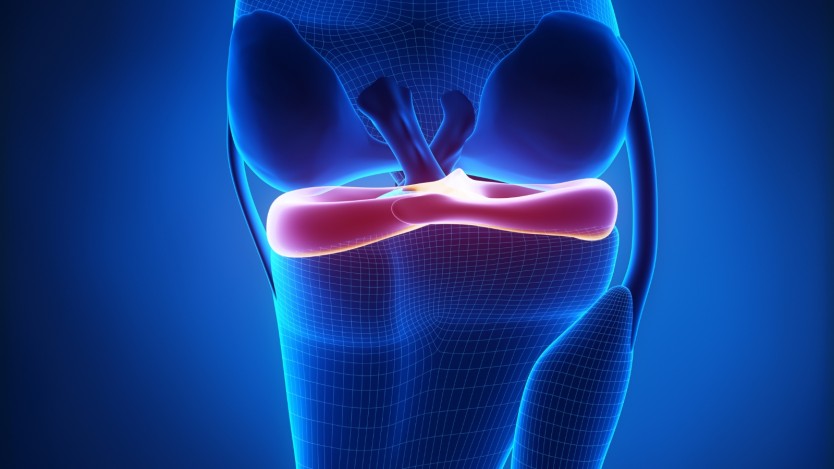
In addition, these cartilaginous elements, among which the menisci stand out, are the ones that manage to absorb most of the shocks and pressures that we generate with movement to prevent damage to other structures.
The menisci are thicker on the outside and become thinner towards the inside. They are located between the femur and the tibia, inside the knee joint.
The vascular and nerve components of the knee are abundant and are distributed between the bone and muscle components. These structures are essential to nourish the bone and muscle substances so that they can carry out their functions and, through nerve transmissions, they are able to choose the movements of the joint and know the positioning of the bone and vascular components.
How do meniscus injuries occur and how are they treated?
Menisci are often injured by sudden rotational movements of the knee with a strong impact. It is common that during sporting activities a sudden movement in a knee position can occur that compromises the internal structures, as in this case the meniscus. If the knee is in maximum rotation, both inward or internal rotation and outward or external rotation, and suffers a sudden increase in pressure, the chances are increased that the inner part of the meniscus, which is thinner as we said before, may rupture or fissure.

Sometimes recovery or improvement of the meniscal tear is possible through conservative treatment, based on early rehabilitation and anti-inflammatory analgesia (especially when the tear is mild and there is no blockage of the knee). In all other circumstances, however, surgery is usually the definitive solution to achieve the most natural recovery of knee function possible.
Is rehabilitation important after meniscus surgery?
Rehabilitation of the operated joint or bone component is always important after every trauma intervention, but in the case of the knee and meniscus, the early start of mobilisation, always in a progressive manner and in accordance with the type of intervention performed and the characteristics of each patient, ensures that the full functionality of the operated knee joint is recovered in the shortest possible time and thus minimises the complications or sequelae of the injury.
Full recovery takes from a few weeks to around 3 months after meniscus surgery, depending on the technique used.
In general terms, we can say that with appropriate rehabilitation, as early as possible, we can improve the range of mobility of the joint to the maximum allowed by the characteristics of the joint, recover the muscle strength lost as a result of post-surgical immobilisation (it is estimated that between 20% and 40% of strength can be lost in the extensor muscles and 20% in the flexor muscles) in 3-4 weeks, and achieve control of the affected knee joint in less than 2-3 weeks.
In the field of sports, the early initiation of appropriate rehabilitation can improve physical performance in almost all sporting activities as well as reduce recovery times and promote and accelerate the gradual reintroduction to the sporting activities previously performed.
What is rehabilitation like after meniscus surgery in the knee joint?
Whenever we talk about rehabilitation and its exercises in the process following meniscus surgery in the knee joint, we must take into account 4 general measures:
- We must establish an exercise programme.
- This programme must be accompanied by other therapeutic and preventive measures.
- The exercise programme must be adapted to the pathology that has been resolved and the type of intervention carried out.
- The exercise programme must follow a series of phases in which it is not possible to move on to the next phase without fulfilling a series of objectives from the previous phase. This programme of phases is and must be individualised, taking into account the patient, the patient's chronic diseases and comorbidity, his or her chronic treatments and the type of operation he or she has undergone.

Now that we have established basic guidelines for knee joint meniscus rehabilitation, we can delve a little deeper into the common characteristics that define them, even though we know that an individualised plan is essential and necessary to achieve the best rehabilitation for each patient.
Are painkillers important during rehabilitation from meniscus knee surgery?
Taking painkillers and anti-inflammatory drugs during the first few days after knee meniscus surgery has been shown to be very effective in controlling pain and allowing the patient to start rehabilitation as soon as possible.
However, this medication should always be supervised by the doctor performing the operation and under no circumstances should it be taken beyond the doctor's instructions.
Taking anti-inflammatory drugs in a disorderly and prolonged manner can be detrimental to health, so all medication should be monitored and controlled by the medical staff.
What postural measures improve the rehabilitation of meniscus surgery?
The first postural measure after meniscus surgery of the knee joint is to attempt early mobilisation of the person who has undergone the operation. It is important that in the first 24 hours the operated knee joint is not mobilised, but this does not prevent the patient from making postural changes to ensure that mobilisation of other parts of the human body begins in order to minimise atrophy of other muscle components.
As the individualised phased programme progresses and achieves its objectives, it is important that the leg of the operated knee joint remains elevated with respect to the patient's heart, so as to promote venous return of the operated limb and minimise swelling and the appearance of oedema typical of the surgical intervention.
What are the stages and time to full recovery in rehabilitation after meniscus knee surgery?
Generally speaking, we can say that during the first few days, taking into account the first 24 hours or so of rest, isometric exercises are important. These exercises are characterised by the strengthening of the muscle components surrounding the joint and allow it to function without mobilising the knee and without adding load to the movement.
Examples of these isometric rehabilitation exercises include the isometric contraction of the quadriceps (a technique that consists of placing a towel or cloth not too high below the operated knee and trying to flatten it by exerting force with the quadriceps) and the lateral elevation of the affected limb when the patient is in a lateral position lying on a flat surface, at a more advanced stage of the rehabilitation programme.

Free Assessment for Contracting Medical Services
Operarme’s Patient Service will contact you and solve all your questions on the medical service you need.
A second group of knee rehabilitation exercises, always taking into account the 4 general concepts that individualise the programme and the type of surgical intervention performed, could be the exercises of flexion and extension of the joint without load and lying down at first, against gravity (sitting on a chair) afterwards and with load lastly.
Some of the most commonly performed exercises during recovery are joint flexion and extension exercises without load and lying down.
These exercises are not usually performed in the first few weeks if the operation has been to partially suture the meniscus due to the risk of tearing or detachment of the stitches, although in recent years there have been branches contrary to this theory that recommend mobilisation in flexion up to 90º as early as possible. Currently, there is no clear consensus, so it is generally preferred to be more conservative.
In the case of a meniscal suture, two weeks after the operation and after removal of the stitches, the patient may begin to ambulate with the aid of crutches without load or flexion of the operated knee joint. At 3 weeks it is possible to begin progressive flexion of the knee with a hinged knee brace that limits movement between full extension and 90° of flexion.
Between 3 and 6 weeks, new exercises are added and the load is implemented with each exercise. Generally, 6 weeks is the limit after which the patient can return to daily activity relatively normally. Between 3 and 6 weeks, intense physical activity, kneeling, crawling, squatting and prolonged standing are not recommended. After a partial meniscectomy, however, weight-bearing is usually allowed from the first days and recovery is faster.
Bibliography
- Instituto Cordobés de Traumatología. (2003, octubre). Protocolo de rehabilitación de la sutura de menisco. http://institutocordobestraumatologia.com/pdf/Rehabilitacion%20sutura%20menisco.pdf
- Busto Villarreal, J. M., Liberato González, I., & Vargas Sánchez, G. (2009). Lesiones Meniscales. Medigraphic, 5(1), 39-48. https://www.medigraphic.com/pdfs/orthotips/ot-2009/ot091d.pdf
- Alan Barber, F. (2013). Rehabilitación acelerada en reparaciones meniscales. Artroscopia, 10, 206. https://www.revistaartroscopia.com/ediciones-anteriores/54-volumen-05-numero-1/volumen-1-numero-2/345-rehabilitacion-acelerada-en-reparaciones-meniscales
Come to Spain for your surgery or treatment
We manage everything from start to finish
Dr. Antonio Rebollo Marina
Médico Asistencial en Centro Médico Caser
Nº colegiado: 282834715

Medical disclaimer: All the published content in Operarme is intended to disseminate reliable medical information to the general public, and is reviewed by healthcare professionals. In any case should this information be used to perform a diagnosis, indicate a treatment, or replace the medical assessment of a professional in a face to face consultation. Find more information in the links below:
Frequent Questions
-
After a meniscal suture, the tissues need about 6-8 weeks to heal; after a partial meniscectomy, recovery is usually faster.
-
Some of the immediate recommendations after meniscus surgery are:
- Use crutches for the first 10 days.
- Keep your knee elevated to control swelling during the postoperative period.
- Do not stand for long periods of time or engage in sporting activities until instructed by the specialist.
-
- Avoid weight-bearing activities or prolonged standing.
- Place cold on the knee and keep the leg elevated with the help of cushions.
- Take painkillers, under medical advice.