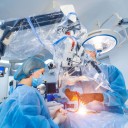
Prostate cancer surgery with Da Vinci Robot


Come to Spain for your surgery or treatment
We manage everything from start to finish
Prostate cancer surgery with the Da Vinci Robot involves the removal of the entire prostate tissue due to the detection of cancerous cells located in the prostate.
To be able to perform a radical prostatectomy (complete removal of the prostate gland and part of the periprostatic tissues), the prostate cancer must be in its initial stage, i.e. it must not have invaded nearby organs and tissues.

Do you need prostate cancer surgery?
Request a free and immediate appointment with our specialists in Da Vinci Robot technique
Radical prostatectomy with Da Vinci Robot has results comparable to traditional open surgery and laparoscopic radical prostatectomy, since all of them consist of the total removal of the prostate gland, but the Da Vinci robotic surgery has the advantage that the surgeon has a 360º visibility in high definition 3D which, together with the great magnification capacity, makes possible a much more precise and complete surgery, avoiding leaving any gap of cancerous tissue.

The Da Vinci Robot gives the surgeon 360° visibility of the inside of the patient, high-definition 3D imaging and greater manoeuvrability than the human wrist.
All this added to the advantages of being a minimally invasive surgery that significantly improves recovery times and hospital stay while minimising the chances of human error thanks to the software that controls the Da Vinci Robot.
Below is a step-by-step explanation of how a prostate cancer operation with the Da Vinci Robot is performed.
Prostate cancer surgery with Da Vinci Robot: step by step

Da Vinci Robot prostate cancer operation is a minimally invasive procedure that significantly improves the manoeuvrability and visibility difficulties of laparoscopy, making robotic surgery the most recommended option for performing a radical prostatectomy.
- Hospital admission and anaesthesia. The patient is admitted to hospital the day before or the day of the operation, depending on the time the procedure is to be performed. It is important that the patient follows the preoperative instructions given by the doctor during the previous consultation, such as antibiotic treatment to avoid infection. Once at the hospital, the patient is asked to undress and put on an operating gown to be taken to the operating room. There, you will lie down on the stretcher and the anaesthesiologist will administer the general anaesthesia. The anaesthesiologist will remain in the operating theatre throughout the procedure to monitor the patient's vital signs and prevent any complications.
- Medical team present during the procedure. During the prostate cancer surgery with the Da Vinci Robot, the medical team present during the operation consists of the anaesthesiologist, a nurse and two surgeons, one of whom will control the Da Vinci Robot and the other will assist you laparoscopically by passing the necessary materials.
- Start of the intervention. Between 4 and 5 mini-incisions are made in the patient's abdominal area and carbon dioxide is inoculated into the abdominal cavity to keep it inflated and thus improve the manoeuvrability of the Da Vinci Robot while preventing possible damage to nearby organs. The doctor at the robot's console then inserts the Da Vinci Robot's surgical arms through the mini-incisions while the other surgeon uses the laparoscope to assist him.
- Prostate removal. Once inside, the surgeon uses the Da Vinci Robot's highly mobile mini-tools, along with the 360° 3D augmented visibility to remove all the necessary prostate tissue. All this work is done with great precision because the Da Vinci Robot's hand does not tremble and its software prevents human error, so preserving the muscles and nerves responsible for erection is more affordable than using other methods. Once the surgeon removes the prostate, it is extracted through one of the mini-incisions.
- Reconnection of the urethra. After removal of the prostate, the surgeon inserts a catheter through the urethra to reconnect the bladder to the outside world, because when the prostate is removed, the part of the urethra that passes through it is severed. To do this, both ends are joined together and sutured. The catheter will remain in place for about a week after surgery.
- Finally, the surgical arms are removed, the incisions are sutured and the patient is taken to the recovery room.
Prostate cancer surgery with the Da Vinci Robot takes between 2 and 3 hours under general anaesthesia, reducing the hospital stay to just 4 days.
Prostate cancer surgery with the Da Vinci Robot lasts between 2 and 4 hours, depending on the patient, offering the doctor a much more precise and less stressful technique, while the patient's recovery and hospital stay are significantly reduced.
Prostate cancer surgery with the Da Vinci Robot is available with Operarme in different hospitals and clinics, which we collaborate with throughout Spain.
If you are thinking of undergoing surgery with this technique, you can request a free surgical consultation with our specialists by clicking below:

Do you need prostate cancer surgery?
Request a free and immediate appointment with our specialists in Da Vinci Robot technique
Come to Spain for your surgery or treatment
We manage everything from start to finish
Medical disclaimer: All the published content in Operarme is intended to disseminate reliable medical information to the general public, and is reviewed by healthcare professionals. In any case should this information be used to perform a diagnosis, indicate a treatment, or replace the medical assessment of a professional in a face to face consultation. Find more information in the links below: