Meniscus injuries: causes, types, symptoms and surgery
- What is the meniscus?
- Causes of meniscus injuries
- What types of meniscus injuries are there?
- Common symptoms of meniscus injuries
- Information about meniscus injury surgery
- Recovery from meniscus surgery
- Do you have a meniscus injury and want to fix it by surgery?

Come to Spain for your surgery or treatment
We manage everything from start to finish
What is the meniscus?
- Meniscus injuries are one of the most common problems in sport, and surgery is only necessary in the majority of cases.
- There are different types of meniscus injuries depending on the area affected, with each type requiring a specific treatment.
- The meniscus injury repair surgery is one of the most frequently performed surgeries at Operarme.
Meniscal injuries mainly involve a tear or fracture of the inner or outer meniscus, causing pain, discomfort and even blockage of the joint. But in order to talk about meniscal injuries, it is important to first explain what the meniscus is and what its function is.
Each of our knees has two menisci that are located between the tibia and the femur, placed on the tibia to be more specific. The meniscus on the inside of the knee is called the medial or inner meniscus, while the other is called the lateral or outer meniscus, which is located on the outside of the knee.
The structure of the menisci is fibrocartilaginous, i.e. they can be perceived as elastic cushions whose function is to act as a shock absorber to reduce friction and friction between the joint surfaces, stabilising and accommodating the joint surfaces and distributing forces and synovial fluid.
Without menisci, joint wear and tear would lead to early osteoarthritis, which is why total meniscectomy (removal of the entire meniscus) is no longer performed today.
During movement, the menisci move, backwards during flexion and forwards during extension.

Do you need meniscus surgery?
Request a free and immediate appointment with our specialists in traumatology
One of the main reasons why surgical treatment is required for meniscal injuries is because they lack blood vessels over most of their surface, which prevents them from regenerating on their own. Only the peripheral area of the meniscus contains blood vessels and nerves, and conservative treatment is possible if the tear is only in that area, or meniscal suturing if surgery is performed.
If we are talking about the rest of the meniscus, the injuries will require surgery to fix them. Although the injury itself does not cause discomfort or pain, these are felt when the irregularities caused by the tear irritate the rest of the joint structures.

Causes of meniscus injuries
Meniscal injuries are usually traumatic in origin, but can also have degenerative causes. It is usually, but not strictly, age-related:
- Injuries of traumatic origin: The menisci of young people are usually very elastic and resistant, which is why injuries usually occur during sports practice as a result of high-intensity trauma involving twisting of the knee.
- Injuries as a result of degenerative processes: Over time, the meniscus loses strength, flexibility and elasticity, becoming dehydrated and weakened. For this reason, meniscus injuries in people over 30 years of age do not require such strong trauma to produce the injury, which is usually minimal and presents few symptoms, although the discomfort is permanent.

What types of meniscus injuries are there?
As mentioned, the types of meniscal injuries vary depending on the intensity of the injury and the amount of meniscus fractured, being mainly of two types:
- Parameniscal injury: Parameniscal injuries are of lesser intensity and the tear is smaller. This occurs in the area around the meniscus, without a complete tear. In these cases it is possible to opt for conservative treatment, avoiding surgery.
- Meniscal tear or meniscal disinsertion: In this type of meniscal injury, the tear is complete and surgery is practically obligatory. This type of tear can occur in both the internal and external meniscus, depending on the way in which the tear has occurred.
Common symptoms of meniscus injuries
The main symptom of a meniscus injury is a popping sound in the knee, a symptom that can be mistaken for a torn cruciate ligament, so it is important to have the patient checked by a doctor to determine the extent of the injury, as the symptoms of meniscus injuries have some specific characteristics:
- Pain: When the meniscus injury occurs, after the snap, the main symptom is pain due to the tear. This pain is moderate but becomes more severe when the leg is rested or the knee is moved. If there is injury to more structures in the knee, the pain will be all over the joint, whereas if there is only meniscal injury, the pain will only be felt in the intra articular line of the knee (the imaginary line that divides the knee into two halves, upper and lower). This localised pain increases if pressure is applied to the area, being slightly lateral depending on which meniscus is affected.
- Articular block: The patient is unable to fully extend the knee, mainly due to the interposition of a meniscus fragment between the tibia and the femur, preventing full movement.
- Joint effusion: This symptom only occurs in the most severe meniscus injuries and is also a common symptom of meniscus injuries. In this case, the knee becomes swollen and it is impossible to move it at all.
- Decreased range of motion: All of the above symptoms together cause a significant reduction in the knee's range of motion, both in flexion and extension.
If the problem remains unresolved for a long time, it is very common for the patient to suffer muscle atrophy in the quadriceps, which will mean a much longer recovery due to the long period of inactivity.

Information about meniscus injury surgery
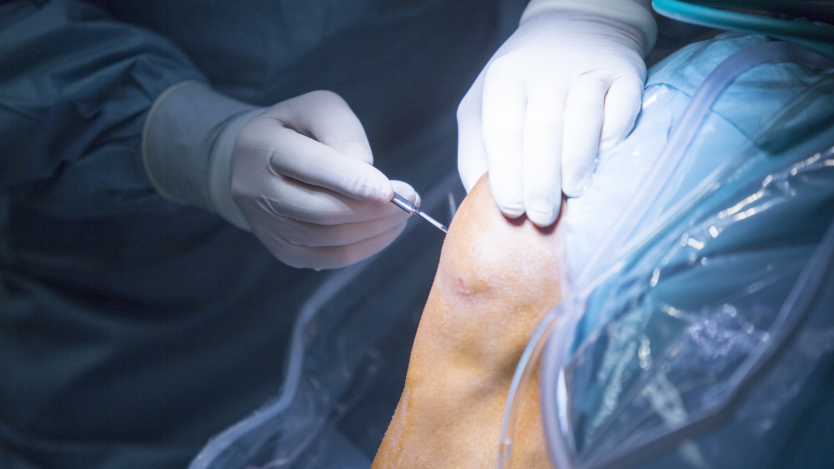
In the event that the patient, following the doctor's recommendations, decides to proceed with the meniscus operation by arthroscopy to correct the injury, it is important that he/she knows the following points, as they will allow him/her to face the surgical procedure with all the information he/she needs:
Cost of meniscus surgery by arthroscopy
In the event that the patient decides to proceed to repair his meniscus injury privately, it is important to know the price that such a surgery usually costs, including materials, medical fees and hospital expenses.
In this case, we extract the information from the price we offer at Operarme, where this price is fixed and all-inclusive, which in this case is €3,390:
- Preoperative study (blood tests, electrocardiogram and chest X-ray according to medical indications).
- Medical and assistant fees until medical discharge.
- Anaesthetists' fees, anaesthesia and medical gases.
- Stay in a single room with a spare bed, hotel service and wardrobe for the patient for 1 day.
- Products for the patient's hygiene and care, disposable and non-disposable, and food for the patient during the stay.
- Expenses related to the surgical act: Booking and use of the operating theatre, medical instruments, equipment, consumables and medications specific to the surgical act (not cytostatics or monoclonal antibodies or derivatives).
- Complementary tests during the hospital stay (analysis, electrocardiogram or chest X-ray).
- Stay in the post-surgical recovery room, monitoring and necessary treatments.
- Post-operative control visits.
In addition, in the case of carrying out meniscus injury repair surgery at Operarme, the company provides the patient with a free taxi service for the day of admission and the day of discharge, thus avoiding having to take the car. Similarly, the patient will have a direct connection with our patient care team to solve any doubts or problems.

Hospital stay during meniscus surgery
If the patient decides to have the meniscus injury repaired, the hospital stay will be one night, until the doctor tells the patient that he or she can go home.
The hospital stay is minimal because the procedure is usually performed by arthroscopy, a minimally invasive surgery that allows the orthopaedic surgeon to correct the problem without the need for open surgery. In some cases, the patient can return home the same day as the operation, although it is advisable for the patient to stay overnight, especially depending on the time the surgery was performed, to see how the surgery has progressed.
What anaesthesia is used for meniscus injury repair?
The anaesthesia used in meniscus surgery by arthroscopy is usually regional with sedation or general anaesthesia, depending on the surgeon's opinion and the patient's health. In order to determine the anaesthesia to be used, a pre-operative examination is usually performed:
- Electrocardiogram: This test will allow the doctor and anaesthetist to know the health of the patient's heart and determine whether it will be able to withstand this intervention.
- Blood test: This test will tell the anaesthetist and the doctor if there are signs of infection, something to be avoided as it could cause complications.
- Chest x-ray: This is usually requested by the doctor when he/she considers it appropriate, and allows him/her to make sure that there is no infection and that the trachea is well aligned with the sternum, in case general anaesthesia is used or if it is necessary to intubate the patient during surgery.
If necessary, the patient will have a consultation with the anaesthesiologist prior to the operation, during which he/she will conduct a medical interview about lifestyle and health habits, thus allowing him/her to establish the exact anaesthesia required for each patient.
What is the duration of meniscus surgery by arthroscopy?
The duration of arthroscopic meniscus surgery varies depending on the severity of the tear, the technique used for the repair and whether or not there are additional injuries, such as ligament damage.
The surgery usually lasts approximately 30 to 60 minutes. The patient will be sedated during the procedure and the surgery is usually over in a flash.

Meniscus surgery by arthroscopy: step by step
- Once the patient and the specialist decide to repair the meniscus injury by surgery and once in the operating theatre, regional anaesthesia is administered to the patient.
- If necessary, the area where the incisions will be made will be shaved, cleaned and disinfected.
- The surgeon will then make 2 to 3 incisions, at his discretion, of between 2 and 4 cm each.
- Through one of these incisions, the specialist will introduce a saline solution with the intention of improving visibility, eliminating any liquid that may cloud the image perceived through the arthroscope.
- The arthroscope is then inserted through one of the incisions. This is a narrow tube with a tiny camera and light at one end, connected via fibre optics to a monitor at the other end, which allows the surgeon to see inside the knee without having to open the joint.
- The other incisions will be used to introduce the surgical tools into the joint to carry out the meniscal repair.
- Normally, the technique used will be a mixture of partial meniscectomy and meniscal suturing, as it is rare that only part of the meniscus is torn. Suturing is only performed on the vascularised part of the meniscus, whereas meniscectomy is performed on the non-vascularised area, as it cannot regenerate on its own.
- When the doctor has finished the surgery, the saline solution, arthroscope and other surgical tools are removed, the incisions are sutured and the dressing is applied. You will then be taken to the recovery room where you will recover from the anaesthesia.
Recovery from meniscus surgery
After the meniscus surgery, the patient recovers in the recovery room and soon after is taken to his or her room, where he or she stays overnight. The following day, the patient can return home, although he or she should avoid putting too much weight on the operated leg.
It is recommended that you start walking with crutches as soon as possible to prevent the operated knee from atrophying and to speed up recovery, as walking encourages blood pumping to the operated leg.
Full recovery after meniscus surgery takes between 1 and 3 months, depending on the individual patient, the intensity of rehabilitation and the surgical technique used.
You can learn all about meniscus recovery by visiting this article: Recovery time after meniscus surgery
Do you have a meniscus injury and want to fix it by surgery?
Remember that at Operarme the surgical assessment consultation with our specialists, so that they can review your case, get to know you and you can decide whether or not to undergo surgery, is immediate and free.
You can request a free appointment by clicking below:

Do you need meniscus repair surgery?
Request a free and immediate appointment with our specialists in Traumatology
Come to Spain for your surgery or treatment
We manage everything from start to finish
Medical disclaimer: All the published content in Operarme is intended to disseminate reliable medical information to the general public, and is reviewed by healthcare professionals. In any case should this information be used to perform a diagnosis, indicate a treatment, or replace the medical assessment of a professional in a face to face consultation. Find more information in the links below: