Knee ligament surgery (cruciate ligaments): cost, duration and step by step
- What is a cruciate ligament tear?
- Why is cruciate ligament surgery performed?
- Knee ligament surgery (cruciate ligament): step by step
- How long does knee ligament surgery (cruciate ligament) take?
- What is the cost of knee ligament surgery (cruciate ligament)?
- Request a surgical consultation with Operarme

Come to Spain for your surgery or treatment
We manage everything from start to finish
- Knee Ligament surgery (cruciate ligaments) has the goal of replacing a damaged ligament with a healthy graft so that the patient can return to normal daily life.
- The duration of knee ligament surgery is generally between 30 and 90 minutes depending on the patient’s case.
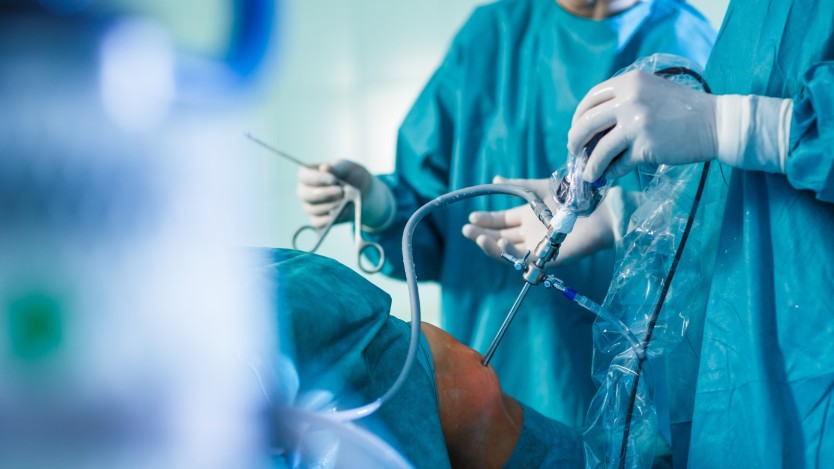
- Cruciate ligament surgery is usually performed via arthroscopy, a minimally invasive technique.
What is a cruciate ligament tear?
Torn cruciate ligaments are one of the most common injuries among athletes and one of the most feared, since surgery is often needed to return to sport (although this decision has to be determined always by a specialist in traumatology).
Cruciate ligaments include two parts: the anterior cruciate ligament, and the posterior cruciate ligament. The anterior cruciate ligament is the one most often injured, due to the strain it is put under in regular sport.

The tear is usually caused by a sudden movement or twist of the body while the foot is planted on the ground. A familiar example is a footballer being tackled by an opponent while his leg is bearing weight.
However, in any sport it is likely to suffer this type of injury due to sudden changes of direction that put excessive strain on the ligament and tear it.
Why is cruciate ligament surgery performed?
The main reason to perform a cruciate ligament surgery is the instability that this injury causes in a patient, making it difficult to walk and carrying on a normal daily life.
In addition, this instability can lead to pain and inflammation in the patient, can increase premature wear of the knee, can affect the meniscus as it will take on more of the load of the joint, and may eventually even lead to the need for a knee replacement.
In some cases, conservative treatment is possible, although it is not usually recommended for people under the age of 40 who lead an active life or play sport, as it can cause a great deal of wear and tear on the knee, as mentioned above.
Ultimately, the best treatment for a tear in the cruciate ligaments is a surgical intervention via arthroscopy.

Do you need knee ligaments surgery?
Request a free and immediate appointment with our specialists in Traumatology
Knee ligament surgery (cruciate ligament): step by step
For the performance of the knee ligaments reconstruction surgery (cruciate ligament) it is common to use an autograft, i.e. the patient's own tendon, such as the bone-patellar tendon-bone (BPTB) graft taken from the front of the knee, or the hamstring tendons.
This technique has two main peculiarities, the first being that as it is the patient's own tissue, the body assimilates it better, and the second is that during recovery the patient may feel pain in the area where the tendon was harvested.
However, the decision of performing a technique or another procedure is only for the traumatologist surgeon to make.
Hospital admission for knee ligaments surgery
First of all, you book a surgical assessment consultation with one of our trauma and orthopaedic surgeons, through our website.
You can ask for an appointment by clicking on the “Make an appointment” button, or filling our contact form here.
Once you have attended the appointment and the surgeon has confirmed the intervention and technique, our patient service team will contact you to inform you about the schedule and coming appointments of the patient’s surgical procedure.

The first step is to attend the preoperative appointment which consists of the following tests:
- Electrocardiogram: This test allows the doctor and anaesthetist to know the patient's cardiovascular health.
- Blood test: it is necessary to determine if there is any sign of infection, which would cause a delay in surgery until it is under control.
- Chest X-ray: This test is only performed if the doctor considers it appropriate and assesses the lungs to rule out problems that could affect the anaesthesia.
Once you have completed the preoperative study and visited the anaesthetist to check the results from the previous tests, you will wait for surgery day.
On the day of admission, our Patient Service team will have handled and scheduled everything for you, and you will just have to go to the hospital with the required documentation and hand it over to the admission staff so they can start preparing you for the intervention:
- First of all, the patient will be placed in the position indicated by the surgeon and the anaesthesia will be administered.
- Next step will be to remove the hair in the area, if necessary, to facilitate the surgical approach.
- The anaesthesia will be administered to the patient, which in this case will be spinal (from the waist down) and sedation, which will allow the patient to be relaxed and even asleep during the intervention, which will pass very quickly. Regarding the anaesthesia, the anaesthetist will keep control of the patient's vital signs at all times, making sure that everything goes well.
- Once the anaesthesia has taken effect, the incisions are made to allow the surgeon to access the area using the arthroscope.
- The specialist makes 2 small incisions on the sides of the knee, which are the places through which the arthroscope and other surgical tools will be introduced. The arthroscope is inserted through these incisions and the torn ligament is located.
- The surgeon then harvests the tendon that will be used as a graft to replace the ligament.
- The next step is to remove the torn ligament and prepare the tibia and femur for the placement of the tendon. To do this, tunnels are drilled in the femur and tibia; the graft is inserted and fixed to the bone with screws or other fixation devices.
- Once the tendon is in place and the knee has adequate mobility, the screw is placed in the tibial tunnel, the incisions are sutured and the surgery is completed.
The next step is to wake the patient up, which is always done in the operating theatre, and then take them to the recovery room where they will remain until their vital signs are completely stabilised. Later, the patient is taken to his/her private room.
The duration of cruciate ligament surgery ranges from approximately 30 to 90 minutes, although it depends on the severity of the injury.
How long does knee ligament surgery (cruciate ligament) take?
Arthroscopic cruciate ligament surgery may last between 30 and 90 minutes, even though it depends on the severity of the patient’s case.
However this length of time only addresses the repair of the cruciate ligaments; if the patient also has a tear in the meniscus, the surgery time will be longer.
What is the cost of knee ligament surgery (cruciate ligament)?
At Operarme, we offer our patients a fixed all-inclusive price for Cruciate ligaments surgery which includes everything necessary for the process to be performed as safely as possible.
The cost of a Knee ligament surgery (cruciate ligaments) through Operarme is 7.790 €, including the following services:
- Pre-operative study, including blood tests, electrocardiogram and, if requested by the specialist, a chest X-ray.
- Medical and assistant fees until medical discharge.
- Anaesthetist's fees, anaesthesia and necessary medical gases.
- Stay in a private room with a spare bed for a companion, hotel and laundry services only for the patient for 1-2 days.
- Hygiene and care products for the patient, disposable and non-disposable, and food for the patient during the stay.
- Expenses related to the surgical procedure: Booking and use of the operating theatre, medical instruments, equipment, consumables and medications specific to the surgical procedure (not cytostatics or monoclonal antibodies or derivatives).
- Complementary tests during the hospital stay (analysis, electrocardiogram or chest x-ray).
- High-quality screws and prosthetic material.
- Post-surgical recovery room stay, monitoring and necessary treatments.
- 2 Post-surgery visits with the surgeon.
- Medical complications insurance, which covers possible eventualities such as the need for an extra day of hospitalisation. Learn more about this insurance service here
We also offer you the possibility of a transfer service to take you to the hospital on the day of admission, and from the hospital to your home on the day of discharge (you can read the conditions of the free transfer service here); as well as support and help of our patient service team, who will guide you and answer any concerns you may have, as well as managing the whole process so that you only have to worry about your health and getting better.
We remind you that you can request a free assessment consultation with one of our specialists to assess your case and treat your ligament problem as soon as possible.
Request a surgical consultation with Operarme
If you are thinking of having surgery but don't know which doctor or hospital to go to, Operarme makes things easier for you by providing you with a free surgical assessment consultation.
You can meet our Specialist in Traumatology and Orthopaedic Surgery in your city, tell him/her about your case, review your reports and medical tests, confirm that you require the intervention and together decide to solve your ligament problem once and for all.
If you need more information about how we work or the Specialist Surgeon we work with in your city, you can contact our Patient Service Team through our contact form, indicating your email address and telephone number.

Assess your ligaments problem with our surgeon
Request a free and immediate surgical consultation with our specialist in Traumatology.
Come to Spain for your surgery or treatment
We manage everything from start to finish
Medical disclaimer: All the published content in Operarme is intended to disseminate reliable medical information to the general public, and is reviewed by healthcare professionals. In any case should this information be used to perform a diagnosis, indicate a treatment, or replace the medical assessment of a professional in a face to face consultation. Find more information in the links below: