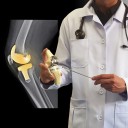
Knee joint anatomy

Come to Spain for your surgery or treatment
We manage everything from start to finish
Knee joint
The knee is a synovial joint, but more specifically it is a hinge joint like the elbow. This joint functions like the common hinges on a door, allowing the leg to bend and thus perform the movement necessary for walking.
Despite the capabilities of the knee joint, it is the joint in the human body that suffers most throughout life because it bears the full weight of the body, leading to wear and tear of the cartilage elements of the joint, a condition known as osteoarthritis.
The anatomy of the knee joint can basically be summarised as 2 long bones covered by a layer of cartilage, which serves to cushion shock and protect the integrity of the knee bones, linked by muscles, ligaments and tendons.
There are two groups of muscles involved in the knee, the quadriceps, which are located at the front of the thighs and allow the leg to straighten; and the hamstrings, which are located at the back of the thighs and allow the leg to bend at the knee.

Regarding tendons and ligaments in the knee, tendons are tough cords of connective tissue that allow muscles to attach to bones, while ligaments are bands of elastic tissue that connect bones to each other.
Ligaments can perform two types of functions in the knee and in any other joint:
- Provide stability and protection at the joints.
- Limit forward and backward movement of the tibia.
What elements make up the knee joint?
As mentioned above, the knee is made up of different types of tissues and elements that together form the joint.
The following is a list of the different elements that make up the knee joint:
- Tibia: The tibia is the bone that forms what is known as the shin bone.
- Femur: This is the bone in the thigh area, running from the hip to the knee.
- Patella: The patella is commonly known as the kneecap.
- The cartilage: As mentioned above, this is the tissue that lines the surface of the joint bone, helping to reduce the friction of movement within the knee.
- Synovial membrane: As with the other mobile joints, the synovial membrane is a tissue that lines the joint, enclosing it in what we would call the joint capsule. This membrane serves an important purpose in that it secretes synovial fluid, which is a clear, sticky fluid, allowing the joint to be lubricated.
- Ligament: As previously mentioned, this is a connective tissue that connects the bones, providing stability and limiting certain movements.
- Tendon: This connective tissue is very strong and connects the muscles to the bones, helping to control joint movement.
- Meniscus: This is an oval-shaped cartilage that is located in the knee joint and other joints, acting as a shock absorber by increasing the contact area of the elements of the knee.

With age and osteoarthritis, the soft elements of the knee, especially the cartilage that covers the bones, deteriorate to the point that they cause discomfort, pain and even deformity in the joint.
These problems cause a very marked decrease in the person's quality of life, which is why Knee Prosthesis Surgery is a solution that should be taken into account.
To learn more about knee prosthesis surgery, click on this link.
If you would like to request a free consultation with our specialists in Traumatology and Orthopaedic surgery, please click in the following image:

Are you looking for a knee replacement in Spain?
Request a free and immediate appointment with our specialists in Traumatology and get a surgery date
Come to Spain for your surgery or treatment
We manage everything from start to finish
Medical disclaimer: All the published content in Operarme is intended to disseminate reliable medical information to the general public, and is reviewed by healthcare professionals. In any case should this information be used to perform a diagnosis, indicate a treatment, or replace the medical assessment of a professional in a face to face consultation. Find more information in the links below: