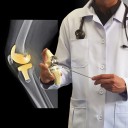
Knee cartilage wear, osteoarthritis

- What is cartilage wear in the knee?
- What are the symptoms of knee cartilage wear?
- How is cartilage wear in the knee diagnosed?
- What is the treatment for cartilage wear in the knee?

Come to Spain for your surgery or treatment
We manage everything from start to finish
What is cartilage wear in the knee?
- Knee cartilage wear and tear is the cause and symptom of osteoarthritis of the knee, and the need for treatment with painkillers and even joint replacement is very common.
- Osteoarthritis or wear and tear of the knee cartilage is diagnosed by a medical interview, with an orthopaedic surgeon or primary care, together with a proper physical examination among other methods.
- If the wear and tear of the knee cartilage (osteoarthritis) increases excessively, knee replacement surgery is likely to be necessary.
Knee cartilage wear is an unmistakable symptom of a process of degeneration and progressive wear suffered by a joint in the human body that is so exposed to the overload of the movements and daily activities of human beings, such as the knee. In this joint, more clearly than in other joints, a process of change and degeneration of its components is produced by the mere fact of its use.
Daily activities and the efforts made over the years mark a degenerative process that reaches its first signs or symptoms from the fourth or fifth decade of life onwards. One of the processes that best reflects this wear and tear of the knee joint, especially at the cartilage level, is the disease known as osteoarthritis.
Knee osteoarthritis is a degenerative, progressive and chronic disease that consists of the degeneration of the cartilage that forms part of the joints of the human body, in this particular case, centred on the knee, in many cases requiring prosthetic replacement of the joint.

Do you need a diagnosis for your knee problem?
Purchase a private consultation with one of our specialists in knee replacement and find a solution now.
Knee cartilage wear and tear or knee osteoarthritis is caused by an alteration in the micro and macrostructure of the components or cells that make up the cartilage structures of the knee. Obviously, the process of cartilage degeneration in the knee joint presents multiple variants depending on the physical and lifestyle differences between individuals.
Repetitive overexertion of the knee joint due to the extreme practice of a particular sport or the performance of a particular type of work that requires minimal but repeated loads over time can lead to the early formation of osteoarthritis or wear and tear of the knee cartilage.
Small anatomical alterations in the conformation of the knee joint that may go unnoticed by patients over long periods of time together with daily activities predispose the components that make up the knee joint to overstress over the years, leading to early signs or symptoms of wear and tear on the knee cartilage or more severe forms of osteoarthritis.

Knee cartilage is a living structure that covers the bones that form part of the knee joint and allows them to move smoothly and precisely with each other, allowing the joint to move.
The alteration that occurs in the wear and tear of the knee cartilage begins with the dysfunction of the cells that make up most of this cartilage, known as chondrocytes. These cells are responsible for forming, regenerating and repairing cartilage in any joint, including the knee. Overpressure, repetitive movements or the simple passage of time cause the chondrocytes to stop making or make less of the proteins needed to form new cartilage, regenerate and/or correct it.
When these alterations overcome the normal functioning parts of the knee cartilage cells, the cartilage itself begins to wear and deform, producing the signs and symptoms explained below.
What are the symptoms of knee cartilage wear?
The fundamental characteristic that occurs when the patient suffers from wear and tear of the knee cartilage is not the mere fact that the cartilages degenerate and stop performing their function properly, but rather it is the consequence of the dysfunction or wear and tear of the knee cartilages that directly affects the function and structure of the bone components that make up the knee.
The upper bony component, the femur, and the lower bony components, the tibia and fibula, no longer glide through the cartilages as smoothly and efficiently as before, thus suffering a higher percentage of pressure with the movements and loads that the knee supports.
This increase in pressure on the bone components produces medium and long-term alterations in them, causing a series of alterations in the bone micro and macrostructure, leading to deformation and new bone generation in locations where there was no bone before, in an attempt to compensate for the loss of function of the cartilage due to the wear and tear to which it is being subjected.
These bone alterations eventually lead to joint stiffness, blocked joint movements and pain.
People suffering from wear and tear of the knee cartilage usually suffer from intense pain, especially at the start of movements, when getting up from a chair, going up or down stairs and at the start of mobilisation. This characteristic pain is due to stiffness caused by the new bone formation caused by the wear and tear of the knee cartilage.
It is usually characteristic for the pain to disappear if the movement continues for a few minutes, mainly due to the ability of all the components that make up the knee joint to adapt to the movement as the knee "warms up". However, after a period of time with the same type of exercise and depending on the degree of wear and tear of the knee cartilage, it is common for the pain to reappear as the adaptation to movement exceeds its capabilities.

It is very characteristic that apart from the appearance of pain as a consequence of the wear and tear of the knee cartilage, there is also a deformation of the knee, which in advanced cases is usually evident to the naked eye, as a consequence of the aforementioned bone alteration.
Swelling of the knee joint is another common consequence of medium to advanced stages of knee cartilage wear. The swelling is caused by an increase in intra-articular fluid, which is normally found in small amounts inside the joint. This intra-articular fluid is called synovial fluid and is secreted by components or cells of a membrane that surrounds the knee joint and helps other elements of the joint to stabilise it during joint movements.
The wear and tear of the knee cartilage increases the pressure on the bone components, as we have explained above, as well as the pressure on the cells that make up the synovial membrane, whose response to stress is an increase in the production of synovial fluid.
Generally, these episodes of knee joint inflammation occur intermittently over time and are directly proportional to overexertion of a knee joint that is already in the early to moderate stages of wear and tear.
How is cartilage wear in the knee diagnosed?
Knee cartilage wear is usually diagnosed by means of anamnesis by the health professional (medical interview), an exhaustive and precise physical examination, as well as basic diagnostic techniques, mainly simple radiology in the anteroposterior and lateral projections, and in cases of doubt or prior to possible intervention, by means of computerised tomography (CT).
What is the treatment for cartilage wear in the knee?
The main treatment for knee wear and tear is to prevent its onset by improving, as far as possible, the overexertion of the knee joint, improving posture and providing adequate rest for the knee joint.
If the onset of signs of wear and tear is already imminent, the initial treatment usually consists of taking analgesics to reduce joint pain and oral administration of chondroprotectors that attempt to delay the loss of cartilage and the subsequent consequences mentioned above.
If the signs of wear of the knee cartilage are already severe or moderate-severe, it is possible to improve the clinical picture with the injection of substances such as hyaluronic acid, which reduce the friction or pressure of the bone components on the worn cartilage. However, this measure only partially slows down the progression of wear and tear and does not provide a definitive solution.
When the wear of the knee cartilage is severe and the alterations of the bone component and the other elements that make up the knee joint are serious, the definitive solution is the replacement of the joint with a partial or total knee prosthesis.

Free Assessment for Contracting Medical Services
Operarme’s Patient Service will contact you and solve all your questions on the medical service you need.
Come to Spain for your surgery or treatment
We manage everything from start to finish
Medical disclaimer: All the published content in Operarme is intended to disseminate reliable medical information to the general public, and is reviewed by healthcare professionals. In any case should this information be used to perform a diagnosis, indicate a treatment, or replace the medical assessment of a professional in a face to face consultation. Find more information in the links below: