Information on sebaceous cysts
- What is a cyst?
- What is a sebaceous or epidermal cyst?
- How does a sebaceous or epidermal cyst form?
- How do we differentiate between a lipoma and a sebaceous cyst?
- What is the treatment for a sebaceous cyst?

Come to Spain for your surgery or treatment
We manage everything from start to finish
- Cysts can be of various types, although the most common is the epidermal cyst.
- The main difference between lipomas and cysts is their consistency and communication with the exterior.
- The only definitive solution for cysts and lipomas is surgical removal.
What is a cyst?
A cyst is defined as a cavity with a liquid or semi-solid content that is lined by epithelium, i.e. layers of skin. A cyst is a very specific formation and we recognise many types of cysts. Generally the most common are epidermal cysts, millium cysts, pillar cysts and some less common ones.
The difference between all these types of cysts is only possible by means of an anatomical pathology study, as it is necessary to see what type of layers cover it in order to be able to give it a name and surname.
Among the diagnostic suspicions that we must take into account when we find a cyst-like lesion are the so-called pseudocysts, which are cavities within the skin but which are not lined or surrounded by epithelial tissue.

Do you need surgery to remove a lipoma or a cyst?
Request a free and immediate appointment with our specialists
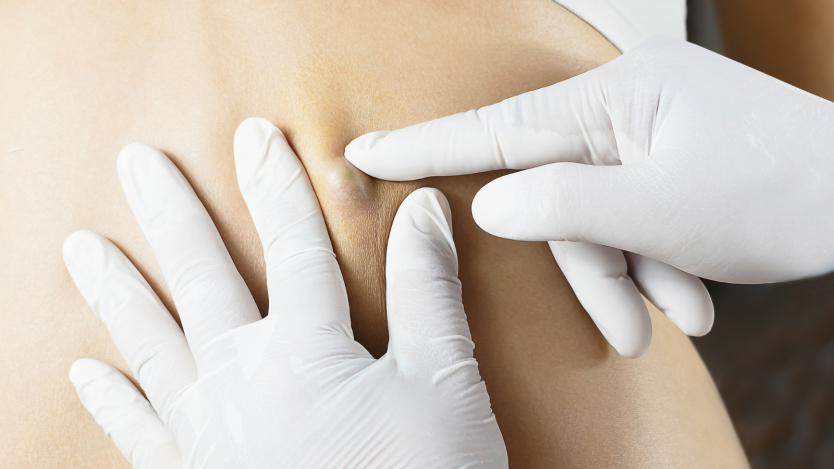
The external appearance of cysts is that of a small protrusion protruding outwards from the skin. It may or may not have a small pore in the centre through which it communicates with the outside.
All cutaneous or skin cysts have their origin in any of the various portions that surround the hair follicle (hair) in any part of the human body with hair growth. Depending on whether the cyst begins to form in any of these parts, we will have different cysts with different characteristics.
What is a sebaceous or epidermal cyst?
A sebaceous or epidermal cyst is a cavity, as explained above, that is mainly filled with dead skin cells, debris or dead skin content. Despite its name, it does not originate in the sebaceous glands and is not caused by an infection.
They are generally always benign. They are usually firm to the touch, mobile and move over the deeper layers, as they are not usually attached to them. They tend to be more frequent on the trunk, face, neck, scrotum or behind the ears. In women, they may also appear on the external genitalia.

How does a sebaceous or epidermal cyst form?
The skin is made up of various substances and throughout our lives it never stops growing; it has been studied that the skin grows at a high rate and is completely renewed every 28-30 days.
The normal growth cycle of the skin is from the inside out. It begins to be synthesised in the deepest layers of the skin and "pushes" the superficial layers, which flake off, i.e. fall off the surface of the human body.
Within the most superficial layers of the skin, keratin (a protein with a fibrous structure, very rich in sulphur and very resistant) forms its most important component. Keratin is found in structures as different in hardness as skin, hair or nails. The difference in hardness is explained by the different compaction of the keratin as the skin layers are pushed outwards.
In the formation of a sebaceous cyst, a portion of the epithelium, usually from the hair follicle, becomes trapped under the skin and forms a cavity that keeps producing keratin inside.
When sometimes the cavity communicates with the outside, it is possible that the microorganisms that we all have on our skin can access the cyst and can overinfect it, at this point we will talk about an over-infected sebaceous cyst in which the treatment is different from the non-infected or simple sebaceous cyst, as we will see later on.
How do we differentiate between a lipoma and a sebaceous cyst?
A lipoma is a soft, rubbery lump formed by the accumulation of fat. It differs from a cyst in that a lipoma is not a cavity that is filled with material but is itself a compact mass. It is usually softer than a cyst and lies in the fatty tissue under the skin.
It does not have a communication to the outside as a cyst can have and it is very rare for it to become infected.
Treatment for lipoma is usually surgical if we want the lipoma to be completely removed.
What is the treatment for a sebaceous cyst?
The treatment for a sebaceous cyst will depend on whether what we have is a simple, non-infected cyst or whether it is infected due to the communication with the outside world as mentioned above.
If the cyst is infected, there are two treatment options. On the one hand, if the infection is still recent and what we find is a hard and inflamed cyst but no collections of pus can be seen, it is usually more effective to treat it with antibiotics for at least a week and wait for the infection to pass and for it to become a simple cyst.

Do you need surgery to remove a lipoma or a cyst?
Request a free and immediate appointment with our specialists
If the infection is more advanced over time and we can see a collection of pus (in these cases there is usually a lot of pain and the appearance is redness with a whitish centre) the best treatment is to make a small cut in the centre of the infected sebaceous cyst and let the collection of pus from inside the cyst drain outwards, sometimes it is necessary to squeeze to completely eliminate the remains of the infection.

Then leave a gauze soaked with an antiseptic agent for a few days and let it close on its own and turn into a simple sebaceous cyst again.
The treatment to completely remove a simple sebaceous cyst is surgical removal. To do this, it is necessary to make a small cut around the cyst and remove the cyst in its entirety. If we do not completely remove the capsule from the cyst cavity, it is possible that the cyst will reappear over time.
This type of operation usually has minimal complications; the only possible complications are slight discomfort in the hours following the operation. The surgery does not require hospitalisation; stitches are necessary, the number of which depends on the extent of the cyst.
The surgery usually lasts between 15 minutes and half an hour.
Come to Spain for your surgery or treatment
We manage everything from start to finish
Medical disclaimer: All the published content in Operarme is intended to disseminate reliable medical information to the general public, and is reviewed by healthcare professionals. In any case should this information be used to perform a diagnosis, indicate a treatment, or replace the medical assessment of a professional in a face to face consultation. Find more information in the links below: