How is the cruciate ligament repaired?
- What is the anterior cruciate ligament?
- Synthetic ligaments, xenografts and allografts
- Cruciate ligament reconstruction by autografting

Come to Spain for your surgery or treatment
We manage everything from start to finish
- Reconstruction of the anterior cruciate ligament is usually performed by tissue autograft.
- Over time, attempts have been made to use synthetic or biological materials from other species, but they have not worked well.
- At Operarme, cruciate ligament reconstruction is performed by autograft.
What is the anterior cruciate ligament?
The anterior cruciate ligament (ACL) is one of the four ligaments responsible for the stability of the knee. It is a strong fibrous tissue that connects the femur to the tibia.
A partial or complete tear of the ACL will cause knee instability.
A choice between conservative treatment and surgical reconstruction of the ligament is available to treat an ACL tear.
The latter is usually chosen for young and athletic patients. There are several types of grafts that can be used to reconstruct the ACL and these are discussed below.

Do you need cruciate ligaments surgery?
Request a free and immediate appointment with our specialists in Traumatology
Synthetic ligaments, xenografts and allografts
In the 1980s in most cases synthetic ligaments were used and the operation was an open surgery. The results of synthetic ligaments were poor, they ruptured easily and did not withstand physiological loads. They often caused synovitis.
Then xenografts were used, i.e. tissue from a different species than human beings. After these experiments, biological grafts were used, both autografts and allografts.
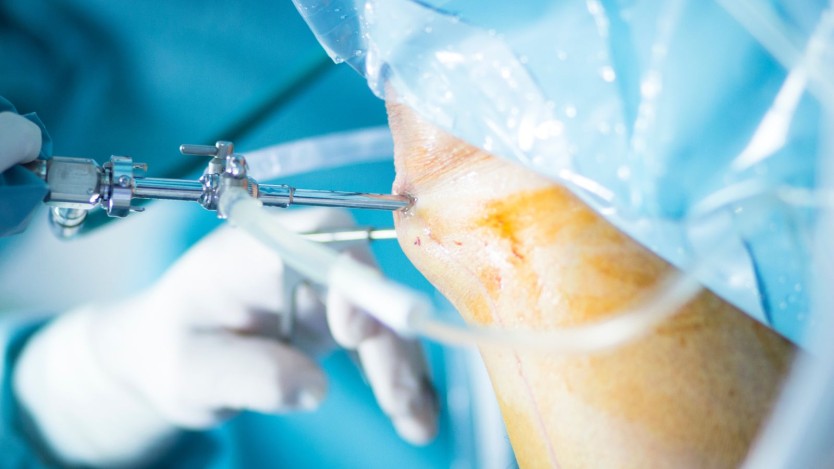
These grafts are the most widely used, especially the autograft, which is the one we use at Operarme nowadays, and the surgery is normally performed by arthroscopy.

Allografts are tissues that are transplanted from one person to another from a cadaver. In this case the morbidity of the donor site is eliminated, the operation and rehabilitation time is reduced.
The patient will have less pain. In the case of allografts there is a risk of contracting infections or the risk of immunological alteration. It is advisable to avoid the use of allografts in young and active people, or those who want to return to high-performance sports, as the number of failures is quite high.
However, this type of graft is recommended for active or sedentary adults who want to return to work quickly, with no expectation of sports participation before one year.
Cruciate ligament reconstruction by autografting
An autograft is tissue that is transferred from one place to another in the body.
The most commonly used autografts are: bone-patellar tendon-bone autograft, semitendinosus and/or gracilis tendons and the quadriceps tendon.
Autografts are the most widely accepted because of their excellent biocompatibility, immediate availability during the technique.
They cannot transmit diseases like allografts. However, they produce weakness and damage at the extraction site.

The bone-to-bone-patellar tendon (BTH) autograft is the most widely used of all autografts. Its advantage is that it allows bone-to-bone healing in the femoral and tibial tunnels and this allows faster healing. In the case of this type of graft, anterior knee pain occurs more frequently.
The bone-to-bone patellar tendon graft is more recommended for young people and young adults who have an active life or for young women who have already had a previous reconstruction.
This graft is not recommended for people with a small patellar tendon or a history of patellar tendinopathy or for workers who require kneeling.
The graft is the central portion of the patellar tendon that is harvested with bone plugs from the patella and tibia.
Semitendinosus and/or gracilis or hamstring tendon grafts cause less anterior knee pain. A major advantage of this graft is that it decreases morbidity on the donor side compared to a bone-patellar tendon-bone autograft.
Removal of this graft causes a deficit in muscle strength.
This type of graft is indicated in young people and young adults with patello-femoral problems but is not recommended in the case of previous anterior cruciate ligament injury, ligament laxity, previous hamstring injury and when the patient is involved in acceleration-deceleration sports.
The quadriceps tendon as a graft is an option when other tissues have already been removed.

Do you need cruciate ligaments surgery?
Request a free and immediate appointment with our specialists in Traumatology
Come to Spain for your surgery or treatment
We manage everything from start to finish
Medical disclaimer: All the published content in Operarme is intended to disseminate reliable medical information to the general public, and is reviewed by healthcare professionals. In any case should this information be used to perform a diagnosis, indicate a treatment, or replace the medical assessment of a professional in a face to face consultation. Find more information in the links below: