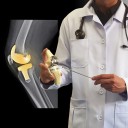
Components of a knee prosthesis


Come to Spain for your surgery or treatment
We manage everything from start to finish
- Knee prostheses were once hinge-shaped, but with technical advances, today's prostheses resemble a human knee.
- Knee prostheses are composed of three elements, the femoral component, the tibial component and the patellar component, which is not always implanted.
- Knee replacement surgery is performed with the aim of improving the patient's quality of life.
The knee prosthesis is, together with the hip prosthesis, one of the most important medical advances of the 20th century. The work of doctors and engineers in the creation of these prostheses was, is and will be decisive due to the continuous increase in human life expectancy. With age, the chances of suffering from degenerative or rheumatic diseases, such as osteoarthritis, increase due to the wear and tear of the joints.
When this happens, the patient suffers so much pain that in many cases he or she is unable to lead a normal life.
In addition, the deformity and loss of mobility further diminish the patient's quality of life by preventing them from climbing stairs, walking and even sleeping at night due to pain.
To cope with these symptoms, there are medications that allow the patient to alleviate the pain and lead an acceptable life.But as the deterioration of the joint due to osteoarthritis or another degenerative disease increases, these medications are no longer effective and make it more difficult to lead a normal life.
In these cases, knee replacement surgery is the most appropriate solution to solve these problems and is performed to improve the patient's quality of life. The first knee prostheses that were created were hinge-shaped, something that limited the possibilities of the knee prosthesis despite its validity.
Today, with technological advances and the experience gained, knee prostheses are practically the same as a human knee, both in function and stability, although it is important to say that a natural knee will always be better than a prosthesis. At least for the time being.
The main components of the knee prosthesis are three, the femoral component, the tibial component and the patellar component.
Femoral component
This part of the knee prosthesis is the part that replaces part of the femur. The femoral component has the same shape as the femur and depending on the type of knee prosthesis, total or partial, it can be bilobed (two lobes) or have only one lobe. To anchor the different components of the knee prosthesis to the bone, bone cement may or may not be used, depending on the quality of the patient's bone.

Tibial component
As the name suggests, this component is the one that is anchored to the tibia. This prosthesis has a flat shape and in the case of a total prosthesis, this component houses the two protrusions resulting from the femoral part of the prosthesis in two concavities located in the upper part of the tibial component.
A high-density polyethylene plate is anchored to this component, which is the part that will be in contact with the metal part of the femoral component, acting as the meniscus.
Patellar component
This component of the knee prosthesis is the one that is implanted in the kneecap and is not always necessary. In many cases it is simply cleaned to adapt it and fit it to the new prosthesis.
This component is made up of a metal part that is in contact with the patella bone and a smooth-surfaced polyethylene part (to allow sliding) that is in contact with the femoral component.
This implantation is not always necessary and depends both on the degree of deterioration of the patella and on the surgeon's judgement.
In addition to this type of component, knee prostheses require other elements such as screws and others that are not specified in this text.
To learn more about the knee prosthesis operation, click on the following link:

Do you need knee replacement surgery in Spain?
Request a free and immediate appointment with our specialists in traumatology
Come to Spain for your surgery or treatment
We manage everything from start to finish
Medical disclaimer: All the published content in Operarme is intended to disseminate reliable medical information to the general public, and is reviewed by healthcare professionals. In any case should this information be used to perform a diagnosis, indicate a treatment, or replace the medical assessment of a professional in a face to face consultation. Find more information in the links below: