Colon cancer surgery with the Da Vinci robot: duration, price and step by step
- What is colon cancer?
- What is the Da Vinci robot?
- Why is robotic surgery used to remove colon cancer?
- Who is a candidate for Da Vinci robotic surgery?
- Colon cancer surgery with the Da Vinci robot, step by step
- Duration of colon cancer surgery with the Da Vinci robot
- Price of colon cancer surgery with the Da Vinci robot
- Request a free surgical assessment with a specialist

Come to Spain for your surgery or treatment
We manage everything from start to finish
What is colon cancer?
- Colon cancer is the development of one or more malignant tumours in the last part of the digestive tract.
- The main causes of colon cancer are changes in the DNA of the patient’s cells, which activate oncogenes or switch off tumour suppressor genes.
- One of the most effective solutions to remove the tumours and restore normal bowel function is surgery with the Da Vinci robot.
In this article we explain the different aspects of robotic surgery to remove colon cancer: the disease, the Da Vinci robot, the surgical process and how we work at Operarme to offer you the best conditions and medical services.

Advice on our medical services
Our Patient Care team will contact you to explain all the details of the service
Colon or colorectal cancer is a disease that starts in the colon or rectum, located in the final part of the digestive tract. The colon, which is part of the large intestine, is about 1.5 metres long.
The large intestine is the last part of the digestive tract and is made up of the caecum, where the small intestine ends; the ascending colon, which rises up to the liver; and the transverse colon, which crosses the abdomen. From there, the colon descends to the rectum and finally to the anus, through which faeces are expelled. The ascending and transverse colon absorb water and electrolytes, while the descending colon and rectum store faecal matter until it is expelled.
This tube-shaped organ is lined on the inside by mucosa, which contains glands that secrete mucus. In most cases, it is in these glands that polyps form and can develop into malignant tumours called adenocarcinomas.
As colon cancer develops slowly, it is relatively easy to detect early and has a high cure rate in its early stages. However, if it has spread, that is, if there are metastases in other organs such as the liver, lungs, bones or brain, the prognosis worsens and treatment becomes more complex.
Today, specialists point to changes in cell DNA as the main cause of cancer. These changes may be inherited, which is less common, or acquired over time, when cell division is altered by ageing, which can activate oncogenes or switch off tumour suppressor genes.

The exact cause of colon cancer is still unknown, but some risk factors are recognised, such as chronic bowel disease, frequent alcohol consumption, smoking, obesity, an unbalanced or high-fat diet, age or a history of previously treated colon cancer.
You can find more information in the article “Colon cancer: what it is, causes, symptoms and treatments”.
Please note that the information provided about this disease and about treatment with the Da Vinci robotic system is general and for information only. The most sensible step is to attend a surgical assessment with the robotic surgery team to answer any questions and plan the procedure.
Read on to find out more about the Da Vinci robot, the robotic system that allows the surgeon to remove adenocarcinomas in a minimally invasive way.
What is the Da Vinci robot?
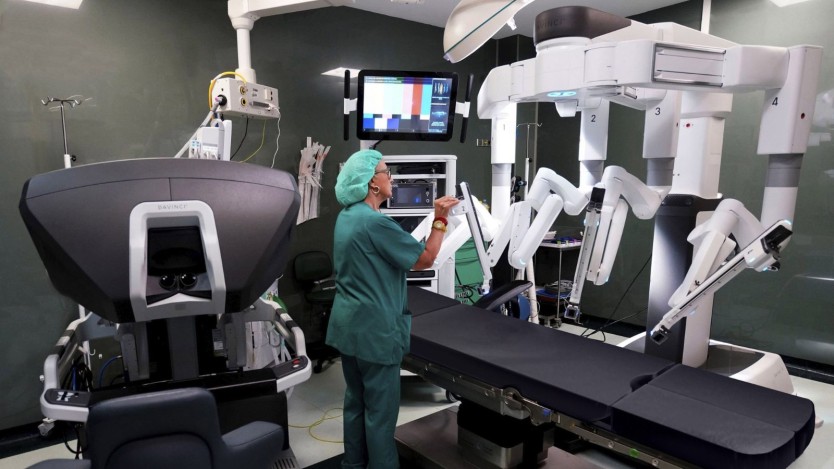
The Da Vinci robot is one of the most advanced surgical systems in the world, offering the surgeon great precision and the patient maximum safety. This robotic technology is used to treat various conditions, such as cancer. Here are the elements that make it up.
The surgeon operates sitting comfortably at a console, handling the robot’s controls and getting a three-dimensional view of the inside of the patient’s body. The robot is made up of:
- The console: through it the surgeon can view the tests carried out before surgery or the location of biopsies at the same time, which helps the surgeon to better understand the anatomy of a tumour or other abnormality during the operation.
- The computer: connected to the console, it is the “brain” of the robot and shows on a screen what the surgeon is seeing and doing. It also allows the surgeon’s assistants to interact with the specialist during the operation, drawing or pointing on the screen.
- The access ports: they are inserted into the patient through small incisions. The robot is docked to these ports and the surgical instruments attached to the robotic arms are introduced.
- The robotic instruments: they follow the surgeon’s hands, giving great freedom of movement, filtering tremor and increasing precision.
- The high-definition stereoscopic vision system: through it the surgeon sees the inside of the patient in three dimensions, as if they were inside the body. This system can magnify the image to see very fine anatomical detail when needed.
You can find a summary of the Da Vinci robotic surgical system in the following video:
Why is robotic surgery used to remove colon cancer?
Although colon cancer can be treated with other approaches such as open or laparoscopic colectomy, the Da Vinci robot has a number of advantages for treating colon problems such as recurrent diverticulitis and, above all, colorectal cancer.
Unlike conventional techniques, the Da Vinci robotic system allows the surgeon to make incisions and movements with millimetre precision, thanks to its ability to scale the specialist’s movements mechanically and digitally and to filter hand tremor. This is especially valuable in operations that require precision and delicacy.
In short, the robotic system performs surgical manoeuvres more accurately and with minimal invasion of the body’s tissues and structures, which further increases the guarantees of the treatment.
Read on to find out who is a candidate for robotic surgery with the Da Vinci system, so that you are well informed and can make the best decision for yourself or for someone close to you.
Who is a candidate for Da Vinci robotic surgery?
To undergo colon cancer surgery with the Da Vinci robot, you need to see an oncologist and a robotic surgery team specialised in this type of treatment. As with any surgery, the specialists must assess each patient’s particular characteristics before deciding on this type of procedure.
It is also essential to diagnose the cause of the problems caused by the malignant tumours, the possibilities of removing them and how the operation may affect your quality of life and general health.
As we have explained, the Da Vinci robotic system is a very precise technology that can be used in many treatments, and it is of course indicated for patients who need colon tumours removed.
There are several types of surgery for diseases affecting the colon, the rectum or both:
- Total colectomy: removal of the entire colon.
- Partial colectomy: removal of part of the colon.
- Hemicolectomy: removal of the right or left side of the colon.
- Proctocolectomy: removal of the entire colon and rectum.
All of them can be performed with conventional techniques, that is, open surgery or minimally invasive laparoscopic surgery. However, as we have explained, robotic surgery allows the surgeon to remove the affected part and reconnect the remaining parts of the digestive tract, restoring normal function and the passage of waste, with greater precision.
Are you looking to solve your colorectal problems with the Da Vinci robot? Request a free, no-obligation surgical assessment through our website:
Advice on our medical services
Our Patient Care team will contact you to explain all the details of the service
Colon cancer surgery with the Da Vinci robot, step by step
On the day of surgery, at the hospital, you will hand in all the necessary documents at admissions and then be taken to a room where you will wait briefly until you are called for surgery.
You will then go to a pre-operative room, where you will be given theatre clothing and an IV line will be placed in your arm, through which the anaesthetic and medication needed for the procedure will be given.
When everything is ready, you will be taken to the operating theatre, where you will meet the robotic surgery team you saw at the assessment, the anaesthetist and one or more nurses who will assist during the operation.
You will be positioned on the operating table and the anaesthetic will be given. Once it takes effect, the incisions needed to operate the Da Vinci robot will be made and your abdomen will be inflated with a gas to improve the surgeon’s view and room to manoeuvre.
The next step is the colectomy to remove the colon cancer:
As mentioned above, a colectomy is the removal of part of the colon to eliminate the tumour cells. There are different types depending on how much colon is removed:
- Partial colectomy: also called hemicolectomy or segmental resection, it involves removing only the part of the colon that contains the cancer, together with a small area of normal tissue on both sides of the tumour. The amount of tissue removed depends on where the cancer is and how large it is. Several lymph nodes are also removed and examined for cancer, and both ends of the colon are then joined to complete the operation.
- Total colectomy: this procedure is not usually performed for colon cancer. It is only done if there is another problem in the colon, as in patients with familial adenomatous polyposis or inflammatory bowel disease.

Once the surgeon has finished, the camera and the robotic arms are removed, the small incisions are closed and the patient is woken up and taken to the recovery room to recover from the anaesthetic.
Colorectal surgery with the Da Vinci robot takes about 3 to 4 hours, depending on the case, and offers very good functional results, minimising the risk of faecal incontinence.
The robotic surgery team will explain at the consultation that, depending on how much colon is removed and your condition, you may need a temporary or permanent colostomy or ileostomy. This basically means connecting the inside of the bowel to a bag placed outside the body to collect faeces.
Duration of colon cancer surgery with the Da Vinci robot
The operation takes about 3 to 4 hours and the patient must stay in hospital afterwards; a hospital stay of around 5 days is recommended. The pain gradually disappears as the wounds heal and the body recovers.
Full recovery and return to daily life will depend on your case, on whether additional chemotherapy or radiotherapy is needed and on your medical team’s advice, so it is best to discuss any questions with them.
Read on for other aspects to consider before deciding to have colon cancer surgery with the Da Vinci robot through Operarme:
Price of colon cancer surgery with the Da Vinci robot
The price of colon cancer surgery with the Da Vinci robot is based on the way Operarme, specialists in surgery, works. Our procedures include everything needed to remove the tumours and repair the colon with maximum safety and effectiveness for the patient, at a fixed, all-inclusive price of €25,000.
What does the price of Da Vinci robotic cancer surgery include?
Here is a breakdown of what is included in the price of cancer surgery with the Da Vinci robotic system at Operarme:
- Booking and use of the operating theatre.
- Private room with a bed for a companion, with meals for the patient for up to 5 days.
- Stay in the post-operative recovery room, monitoring and necessary treatments.
- Pre-operative tests (blood test, electrocardiogram and chest X-ray as medically indicated).
- Post-operative visits until medical discharge.
- Surgeons’ fees.
- Anaesthetists’ fees.
- Nursing team fees.
- Surgical material needed for the operation, theatre monitoring and the Da Vinci robot.
In addition, Operarme offers patients a free transfer service on the day of admission and discharge, so you do not have to drive. Patients also have ongoing access to our patient care department to resolve any questions or issues.
Request a free surgical assessment with a specialist
Are you looking for the best way to solve the problems caused by colon cancer? If you think colon cancer surgery with the Da Vinci robot is the solution that best suits your needs, you can request a free surgical assessment with our robotic surgery specialists to meet them, let them review your case or that of someone you are helping, and decide together on the best option.
Advice on our medical services
Our Patient Care team will contact you to explain all the details of the service
If you have any questions, you can find more information about how Operarme and our specialists work on our website, call us on +34 91 141 33 56 or use our contact form so that we can call you.
Remember that we have a wide range of specialists who can help you improve your quality of life, and our patient care team will be by your side to guide you and manage everything you need throughout the process.
Come to Spain for your surgery or treatment
We manage everything from start to finish
Medical disclaimer: All the published content in Operarme is intended to disseminate reliable medical information to the general public, and is reviewed by healthcare professionals. In any case should this information be used to perform a diagnosis, indicate a treatment, or replace the medical assessment of a professional in a face to face consultation. Find more information in the links below: