Benefits of cataract surgery
- What are cataracts and why are they operated on?
- What does cataract surgery consist of?
- Benefits of cataract surgery depending on the type of lens used
- Request an appointment for cataract surgery

Come to Spain for your surgery or treatment
We manage everything from start to finish
- After cataract surgery, and regardless of the type of lens implanted, the patient obtains an immediate benefit in their vision.
- The implantation of a monofocal intraocular lens (IOL) requires the use of close-up glasses to focus at short and medium distances.
- Toric IOLs are ideal for correcting astigmatism while treating cataracts.
What are cataracts and why are they operated on?
The crystalline lens is a bi-convex lens that is located at the front of the eye, behind the iris, and is transparent. Thanks to its transparency and refractive power (dioptres), light passing through the eye is projected onto the retina.
With age, this lens in the shape of a lenticule loses its transparency and does not allow light to pass through. As a result, light cannot reach the retina properly and images are blurred or disfigured.

Do you need cataracts surgery?
Request a free and immediate appointment with our specialists
Certain factors, such as diabetes, hypoparathyroidism (with low calcium levels), severe myopia, long-term corticosteroid treatment (COPD, rheumatism, etc.) or prolonged sun exposure (construction workers, fishermen, etc.), can lead to early cataracts.
However, cataract surgery is one of the most pleasant procedures available, as the patient immediately notices the improvement in his or her vision. As soon as the operation is over, patients notice how their eyesight clears up: it is something like cleaning foggy glasses and leaving them shiny and transparent.
What does cataract surgery consist of?
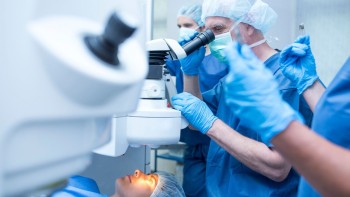
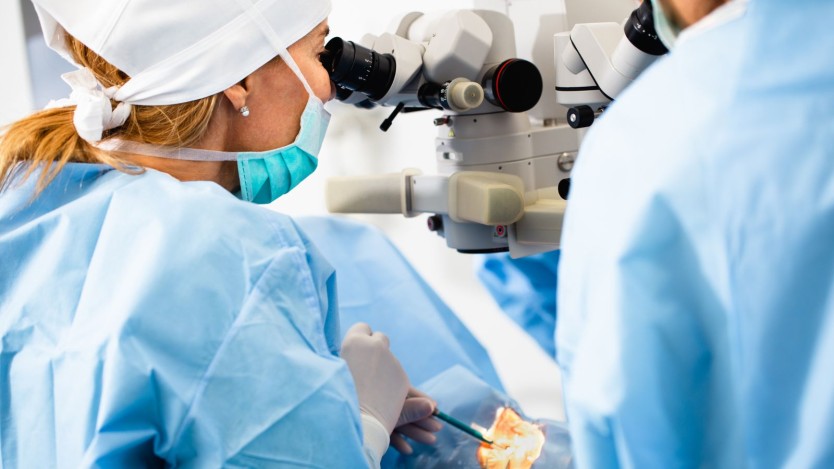
Cataract surgery takes just over 20 minutes for each eye. It is performed under local anaesthesia, using eye drops that anaesthetise the sensitivity of the eye.
The patient will not feel any pain, discomfort or manipulation. If the patient takes anticoagulants (such as Sintrom) or antiplatelet drugs (such as aspirin), the specialist will advise whether to continue or adjust them; in most cases they do not need to be stopped for cataract surgery, and they should never be stopped on your own initiative.
All of this should be discussed with the specialist in the pre-surgical assessment consultation.
Cataract surgery is very simple: it consists of making a very small incision in the outer circumference of the cornea, approximately 2mm, through which the opacified crystalline lens is removed.
This is replaced by an intraocular lens with a power similar to that of a normal lens, i.e. around 20 dioptres.
If the patient suffers from myopia or hyperopia, these dioptres, of more or less refractive power, can be compensated with the power of the intraocular lens that is placed, correcting the refractive error the patient previously had. In this way, the patient will feel that their eyesight will be as good as new, without having to wear their myopia or hyperopia glasses after the surgery.

An important fact to bear in mind is that the IOL that is placed has the advantage of being for life. It does not need to be replaced. They are made of durable materials.
As for the types of lenses that we can find, there are several types. You can read more about intraocular lenses in this article.
Benefits of cataract surgery depending on the type of lens used
Monofocal lenses
They have the disadvantage that the patient needs glasses for near and intermediate distances because they only have a single sharp focus, which is in the distance. Otherwise, they perfectly correct the vision defects caused by cataracts. And they do not cause glare. They are the ideal lenses for people who do not mind dispensing with glasses to focus at close or medium distances. They do not correct astigmatism.
Multifocal and bifocal
These lenses provide good distance and near vision. There are several types of multifocal and bifocal lenses:
- Refractive. On the anterior surface of the lens there are two spherical areas of different radii in the form of concentric rings. One of the spheres improves distance vision and the other improves near vision. They have a major disadvantage, which is that they produce night flashes and glare.
- Diffractive. Similar in structure to the previous ones: They require very good illumination for the lens to function, which depends on the coexistence of two light beams (one for near vision and the other for distance vision). It also has the disadvantage that this lens can cause ghosting and peripheral light halos. Among the advantages are that, as in the previous case, the patient can dispense with the need for near glasses for focusing.
- Hybrid. They are a mixture of diffractive and refractive lenses, trying to keep the best of each one of them. They have been designed to achieve maximum distance and near visual acuity, but require optimum illumination. This type of lens would not be indicated, because it would not achieve good results, in patients with a history of macular degeneration, glaucoma, dry eye, astigmatism, corneal leukoma.

Trifocal lenses
This type of IOL has three foci in its optical zone, one for distance vision, one for near vision and one for intermediate vision. It provides the ability to focus at three different distances.
Toric lenses
Very suitable for patients with astigmatism because they correct it at the same time as the cataract. A major disadvantage is that they can move and rotate. If this happens in the first or second week after the operation, they can be repositioned by re-intervening.
After this time it is very complicated as the lens is anchored to the eye tissues and it is more difficult to remove it. It is therefore necessary for the patient to have a good anatomical structure of the eye in which to anchor the lens so that it remains fixed and does not rotate. This type of lens is associated with one of the previous ones, i.e. trifocal, multifocal or monofocal lenses can also be toric, to solve both problems at the same time.
Request an appointment for cataract surgery
If you are considering cataract surgery, remember that you can request an immediate, free surgical assessment consultation with one of our ophthalmologists by clicking below:

Do you need cataracts surgery?
Request a free and immediate appointment with our specialists
Come to Spain for your surgery or treatment
We manage everything from start to finish
Medical disclaimer: All the published content in Operarme is intended to disseminate reliable medical information to the general public, and is reviewed by healthcare professionals. In any case should this information be used to perform a diagnosis, indicate a treatment, or replace the medical assessment of a professional in a face to face consultation. Find more information in the links below: